Trick-or-Treat Cheat Sheet

When our children were very young, we trick-or-treated in a neighborhood of Los Angeles where our good friends lived. It just so happened many scenic and sound design, as well as prop folks, who worked in the movie industry, lived here. Hollywood loves Halloween. It was not uncommon for a home owner to create a haunted house in his or her front yard, or for macabre Halloween scenes to be staged in rented trailers and placed in driveways.

IMG_7385

As new parents, this holiday geared toward children, celebrated in a truly fantastic way, hardwired its way into the robust and fun experiences we wanted to give our children in their childhood.

IMG_7381

Fast-forward about 1,800 miles and almost two years, when our son was diagnosed with type 1 diabetes; last Halloween was his first trick-or treating experience with type 1 diabetes. Halloween is just one of the many occasions that makes parents of children with type 1 diabetes more creative, vigilant, and exasperated.

I understand, there’s multiple ways for families living with type 1 diabetes to navigate Halloween: a candy buy back, or perhaps a “switch witch” leaves a desired toy in exchange for a pile of candy.

Last year, I fretted and worried. We put out a teal pumpkin, and yet I was determined that our son would experience every ounce of this holiday, just like any other kid with a fully functioning pancreas. Secretly, I was prepared for a candy buy back. I had a roll of quarters ready, as well as a really neat Lego set two swap for candy, but we didn’t need either.

What we did need, was a really cool cheat sheet that listed common candy servings and carbs. There’s lots of lists out there, but we used one from the JDRF. Here’s this year’s JDRF Candy Carb Counts. I printed several copies to keep in my back pocket and invested in a nice Surefire flashlight. I cranked Henry’s basal up a bit, and in the oncoming cold midwestern winter, this fireman raced door to door, eating chocolate along the way.

Henry's first Halloween with type 1 diabetes

Henry’s first Halloween with type 1 diabetes

You know what? He went low, a couple of times, but no problem. We had a whole bag of fast-acting carbs to deal with that.

Teal Pumpkins Are Hard

So, there’s this awesome dad, who hand delivered notes to his neighbors before Halloween, to explain that his son was on a Ketogenic Diet, and could not have any sugar because it could trigger seizures. The father attached a small toy to each letter, so that his son, like any other goblin, witch, or ghoul, could enjoy trick-or-treating.

Parenting is a paradoxical slog into empathy, sacrifice, and joy. Now complicate that journey with a condition, syndrome, or diagnosis, which means one guiding hand tries to soften the blows the world will deliver, while the other toughens the exterior to face the world. Sometimes, the right confuses the left.

After our three-year-old son was diagnosed with type 1 diabetes, we started seeking out opportunities that would simultaneously educate and prepare our son for the world and the world for our son.

There’s a teal pumpkin project, whose pledge promises “extra kindness to kids” by supplying “non-food treats at the store like glow sticks, stickers, bracelets, and more” on Halloween (www.foodallergy.org). Last year was our son’s first Halloween with type 1 diabetes, so we had a teal pumpkin and passed out stickers, play-dough, and tattoos instead of candy. He trick-or-treated in our neighborhood and collected 100% candy, which we let him eat a little bit of over time, and with a lot of extra insulin. The left and the right.

This year, we were planning the same, but teal pumpkins are hard. While searching for non-food treats at the fourth store in two weeks, I encountered this display:

IMG_7392

in the health food section of our local grocery chain, next to boxes and boxes or gummy treats, which have 17 carbs per pouch, and are most certainly food, violating pledge item #2: “non-food treats.”

So, instead of optimistically shopping in the adjacent town for Halloween non-food treats, I bought three bags of Smarties. I figure the left over Smarties, (6 carbs per roll), will become medicine for my son to treat hypoglycemia.

Ironically, I’ve seen more information and displays about teal pumpkins this year than last, but less feasible ways to create a teal pumpkin trick-or-treating experience. I suppose, with most awareness campaigns, it’s two steps forward and one back. On one hand, it’s good that there’s increased awareness, but the increased awareness shines light on just how gaping and insurmountable the problem is.

Really, I’m not that concerned with how difficult it is to create a house that can host the teal pumpkin project. Rather, I’m concerned with how easy it is not to. I live in the midwest, a region famous for producing corn. Sometimes, I drive just outside of town and am bewildered at the fields, both magnificent and damning.

IMG_7369

What I see has implications beyond type 1 diabetes. I see a tradition of family farms lost to big agribusiness. I see feed-corn, industry, profit, hardly getting-by, and fields and fields of soft drinks (and let me be clear, in the right moment, a soft drink could save my son’s life). I see candy that’s nested in bowls and handed out at banks, offices, and parties. What I don’t see is how we greeted each other before a shelf-stable promise of sweetness.

When my sister and I were little, we trick-or-treated the length of our mile-long dead-end street, past an eerie cemetery, where westward settlers who died on the stagecoach route in the 1700 and 1800s were buried. The very last house on the street was famous, in the neighborhood, for giving out decidedly tongue-in-cheek treats. One year, each trick-or-treater got six pennies, another year a box of raisins; my two favorite years they passed out dental floss and toothbrushes. Kids were always milling around the house, exclaiming in mock-protest, outrage over their treats. But the owners’ message was clear: “You made it this far, now take care of yourselves.”

The message about teal pumpkins is out, but why is it only one day a year? Why are there bowls of candy in offices? Why do kids meals come with free soft drinks and desserts? When did we cross the message of care with sugar?

Cousins First, D-Cousins Second

I helped ease my sister back onto her hospital bed when the afterbirth pains had passed. I stood over her, but she was already asleep, a grimace  of pain and sadness etched her frown, even in sleep.

Less than 24 hours ago she’d had an emergency cesarean to deliver her 33 week old twins. Baby B was showing distress. The twins where delivered at 5:06pm and 5:08pm, and whisked to the NICU. Rebecca and her husband were called into the NICU at 2:00am to meet their babies, but before she could see her babies, still in the wheelchair, the doctor asked if they’d had prenatal chromosomal testing. Twins are automatically considered high risk, so they’d had every test. She was told her son had Down syndrome before she ever got to see or touch him.

She was told how the world would see her son before she ever saw her son. When any infant or child is diagnosed with a condition, syndrome,  or disease, the parents need to grieve for the life they’d expected for their child, then, without much flourish, put that life away and show up for the life that is. Rebecca showed up. Before Everett was discharged from the NICU, he had a team of therapists waiting for in-home visits.

When Rebecca and I talk about this moment she asks, “Why wasn’t I allowed to meet my son before someone told me what was wrong with him? Why did someone tell me what my son couldn’t do before I saw him? Why can’t people see what he can do?”

Two months later, the twins were healthy and home, but my husband and I were in the hospital with our son, Henry, who was just diagnosed with type 1 diabetes. A week later, we had our first follow up at our local doctor’s office, and the nurse not so much asked as  stated, “Your son, he’s the type 1 diabetic?”

“No,” I said, thinking of my sister. “He has type 1 diabetes.”

Just like his cousin, my son has a diagnosis that will define him, but much of their battle will be for a people to see them as people first. Rebecca knew this all along. Person first language.

D-Cousins

Cousins first, D-Cousins second

About a year after her son’s birth, my sister delivered this speech to a group focused on advocacy for Down syndrome (DS).

Two. This number began popping up in my life. Two blue lines on the home pregnancy test. Two embryos. Two fetal heart beats. Two tiny bodies growing inside of me. Two heads, two hearts, two souls, two babies to join our other two children at home. Everett and Vivienne were born two minutes apart. At two in the morning, only seven hours after they were born, we were asked what chromosomal prenatal testing we did.

I am a planner, so we did every check, test, and measurement throughout the entire high risk pregnancy. Apparently because they are twins, Vivienne “covered up” many of the markers all the specialist and doctors would have looked for with Everett. Before I got to even see or hold Everett, one of my two perfect babies, I was told what was “wrong” with him.

Days later we were shown his karyotype. A karyotype is a picture of a person’s chromosomes. Instead of two 21st chromosomes there were three. Everett has Down syndrome.

The next day was Christmas Eve, and I as discharged from the hospital, but I left my two premature babies in the NICU. They were born two months early, but the babies got stronger, and so did I. Daily I would visit them, but I was torn between the two isolettes.

Not having a prenatal diagnosis of DS forced me to hit the ground running. I had planned for my son to have one life, but now I was planning for him to have another. I looked for specialists, services, groups, funding, schooling, and opportunities for my son.

When Everett was two months old he started receiving services through our state’s early intervention services and as a two person team, we created plans, goals, and outcomes for Everett. When we came across an issue like feeding, sitting, or playing, we problem solved together. Two heads are always better than one.

During the peaceful moments right before bed I think of my two perfect babies and how they came into the world too early. I take their hands or caress their cheeks and I think of all of their cells and chromosomes in their bodies that make them who they are. I can imagine Vivienne’s Karyotype: the two 21st chromosomes next to one another. Then I think back to the time in the NICU when I was alone and scared, when the geneticist displayed Everett’s Karyotype to my husband and me. I remember those three 21st chromosomes lined up next to each other. Now I know that three is just as good as two. Maybe three will be my new lucky number.

Rebecca and Everette

Rebecca and Everette

Hello, We’ll Talk About Diabetes

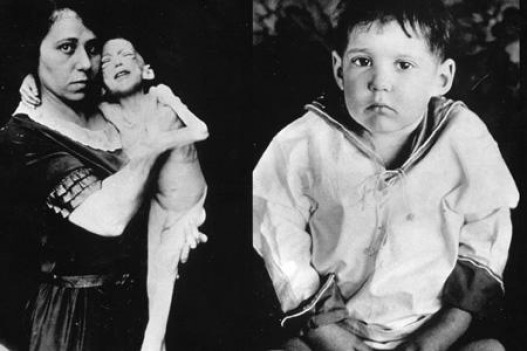
In 1919, eleven-year-old Elizabeth Hughes, daughter of Charles Evans Hughes,
Justice of the Supreme Court, was diagnosed with type 1 diabetes, a death sentence. At the time of her diagnosis, children with T1D survived an average of 11 months after diagnosis. The only “treatment” was the Allen diet, a slow starvation—  eating about 400 calories a day from foods like “thrice boiled cabbage” (Total Dietary Regulation in the Treatment of Diabetes).

L: a child with diabetes on the starvation diet, R: same child after treatment with insulin (photo credit: trumanlibrary.org)

left: a child with diabetes on the starvation diet right: same child after treatment with insulin (photo credit: trumanlibrary.org)

Fortunately, Elizabeth was among the first American patients to receive insulin in 1922. She grew up, married, had three children, and died at age 73. When her children were young, she never told them she had diabetes, not even after her oldest son witnessed her convulsions from a severe episode of hypoglycemia. In fact, it wasn’t until her children were grown that she took each child aside and told them privately that she had diabetes.

Her secrecy made sense. She’d been handed a death sentence at eleven. Even after the discovery of insulin, prognosis wasn’t good. Recently, The New York Times ran an opinion piece, “The End Isn’t Near,” by Dan Fleshler, someone who has been living with diabetes for 53 years. Fleshler was diagnosed at seven, and his doctors weren’t optimistic about his longevity, but he’s healthy and here, yet the looming predictions cut into the quality of his life.

A diagnosis of a disease or a condition creates a stigma, and there’s a deep drive to keep any stigma a secret. However, secrets around disease create misunderstanding, shame, and fear. If people with diabetes and their family members don’t talk about what it’s really like to live with diabetes, then it’s easy for misconceptions such as: “insulin is a cure” or diabetes is “easy” as long as the patient doesn’t eat sugar, to circulate.

It wasn’t until my mid-twenties that I met who someone who was open about T1D. Amy regularly checked her blood sugar and bloused for food without any fanfare and answered all our questions, but I had no idea what it meant to have diabetes. In fact, we were hosting a party, and I made tea sweetened with honey just for Amy, because I knew honey was lower on the glycemic index. I’d thought to measure the honey and let her know how much I used, but I had no idea why it would have been better for Amy to drink something with an artificial sweetener in it, which she did.

A few years later, our son was diagnosed with type 1 diabetes, and I knew we would educate ourselves to help Henry live his life in the best ways we could. However, I thought we’d hunker down and live life with diabetes with relative quietness. And we did for a while, but we started noticing things, like when Henry hears the case of his blood glucose meter being unzipped, he holds out his finger without looking up from his Legos or iPad. We started reading information such as, Type 1 diabetes is increasing by 3% annually and affecting a younger and younger population, with some diagnoses occurring before a first birthday. There’s no disease registry, so T1D can’t be studied in a truly systematic way. Some insurance companies deny coverage for life saving and extending equipment, such as pumps and CGMs, for infants and children. Some schools don’t allow students with T1D to use smart devices, such as an iPod, iPhone, or iPad to help manage blood sugars.

It took me about a year to move from being a parent of a person with diabetes to an advocate for diabetes awareness and research. In fact, I think many parents of children with disabilities, diagnoses, and conditions, to their surprise, define themselves as  an advocate after the emergency settles into the daily.

So, for now, we’re speaking up, telling Henry’s story with the simple belief that story and science should work more closely together. This summer insulin turned 93 and Henry turned 5 in September. If we talk about diabetes enough, maybe one day we can talk about it less.

IMG_7239

To Celebrate

To mark milestones in our family, we usually cook a nice meal and invite friends and family to celebrate with us. Of course there’s a cake, some ice cream, and  a few streamers left over from the previous event, like a baby shower we hosted seven years ago. Instead of planning an elaborately themed party, we enjoy good food and conversation to celebrate birthdays or anniversaries.

Our son, who has type 1 diabetes, turned five this September. He was diagnosed with type 1 at three-years-old, so he’ll probably never remember a life or birthday without this disease. We were planning a party per usual, and I don’t know exactly where the plot shifted, but it did. Henry’s only requests were Toad Cupcakes (à la Mario Kart) and a few Lego sets, but a little planning and a few Pinterest visits later, his 5th birthday was under the big top.

I made this. This is not a Pinterest Fail.

I made this. This is not a Pinterest fail.

We went BIG. I don’t want to say the circus celebration was diabetes related, but I have to admit, our whole family is seeing life and milestones through the lens of diabetes. Sometimes, the future I imagine for my son is grief-worn and full of woe. Other times it’s more kick-ass and victorious. The truth is probably somewhere in the middle with weekly visits to both extremes.

So, this year we erected a massive play structure that was given as birthday present by grandparents:

IMG_7006

We rented a bouncy house:

IMG_7682

We invited the neighborhood kids over to a drive-in move later that night:

IMG_6992

The truth of it is that this year has been hard. Every two days Henry anticipates a painful site change for his pump, which is an improvement over an injection of insulin every time he wants to eat. He waits to eat his food while his blood is checked and other people are already eating. Some nights he drinks juice in his sleep to combat lows. The truth of it is that future years will be hard too, and Henry will grow up before his time, because type 1 diabetes demands attention, focus, and discipline; characteristics not every adult posses.

I don’t believe that disease makes my child an angel or a hero. I realize this statement offends many people. I understand how this statement offends people. However, living with a chronic disease has taught me that the distinction between hero, and sick, and victim aren’t very useful. In fact, the distinctions between most things aren’t very useful. Having type 1 diabetes has made my son’s life more complicated and this makes him one tough kid, because a diagnosis of type 1 doesn’t allow for other options.

I’m cautious to say that living with a chronic disease is instructive. If I could flip  a penny into a magical fountain and wish this away, I’d trade every realization I’ve had about living with a chronic condition before that penny made one full rotation.

However, living with a chronic disease has shown me it’s worthwhile to look for what to celebrate. Sometimes it’s a birthday. Sometimes it’s a blood sugar that’s in range. Sometimes it’s the fact that I don’t cry when my son asks me a really difficult question, like why he has diabetes.

Around our house, most of the recent celebrations are pretty simple: like not being late despite everything we have to do to leave the house, guesstimating the carbs in a restaurant meal of beef tacos with a side of rice and beans, finding just the right spot to start a site, and really, really, really meaning it when we sing “Happy Birthday.”

https://www.youtube.com/watch?v=3pg0qpl6L2g

It’s Never Just a Number

Now is a really exciting time to have type 1 diabetes. I realize how absurd that sounds, but just 18 months ago we joined the diabetes world with a bag of syringes and a log book. A few months later our three year old transitioned to a pump and continuous glucose monitor (CGM). However, the data from pump and CGM were not compatible with a Mac. We found a workaround for the pump’s data through Diasend, but at the time it wasn’t approved for use in the States. Dexcom didn’t send data to anything other than the receiver. So these great tools existed, but they spoke different languages.

Thanks in large part to a vocal patient base, now a plethora of diabetes devices are working to speak the same language. The FDA is releasing products and software faster than anticipated. Just last week Dexcom G5 came out, which means a smart device can stand in for the receiver. Also, there’s the new Mac compatible software, Dexcom CLARITY. Here’s the great part: it works with Dexcom G4 and Dexcom Share. You don’t need Dexcom G5 to use Dexcom CLARITY. All you need is an account at Dexcom to download Dexcom CLARITY on your computer.

Information is power in the world of diabetes. Here’s the CGM data from the last two weeks.

Screen Shot 2015-09-07 at 10.41.36 AM

This is our best day; 74% of the readings were in range. On our best day we got a C-.

There are three common mantras in the diabetes world: numbers are just information, it’s never just a number, and keep calm and treat the number.

A few months after diagnosis, an adult friend with diabetes shared wise advice, “Never call a number good or bad. Just call it high or low.” We adopted this practice immediately, but are only now starting to see the reason.

Before programs like Diasend and Dexcom CLARITY, we looked at one number. If his meter said 70 we gave him a glucose tab or two. If his meter said 220 we corrected with an ezBG. Now we’re looking at aggregate data.

To keep our son’s blood sugar in range my husband and I have to work harder and more consistently on this than most of our daily tasks. We’re doing our best, so it’s easier to hear that he has, “significant time above the threshold from 9:50 p.m. to 12:20 a.m.” than, “those are some bad numbers.”

Right now, our best is a C-, but we have information we’re using to study for the test we’ll take in two weeks when we download the CGM’s data again. We have adjusted his basal program and decreased his bedtime snack bolus.

Here’s a question from next test:

Q. If a number is just information, what’s a gaggle of numbers?

A. Hopefully, a B-.

#DOCburnout2015: Looking Ahead to Diabetes Burnout

The kids are tucked in, the kitchen is cleaned, school lunches are packed, and my husband and I finally sit down to watch a T.V. show before bed. During the opening credits something beeps. We pause the show and listen again for the beep, which could mean a number of things: there’s only 10 units of insulin left in the pump, there’s an occlusion in the pump, our son’s blood sugar is rising (or falling) rapidly, he is high, he is low, something needs calibrating or is out of range, a battery is dying.

Sure enough, there’s the beep again. We look at each other, wondering who’s turn it is to address this diabetes need this time. Diabetes has a knack for needing attention at almost every inopportune moment and roughly every two hours during the night.

Our son is young, so right now we manage his care, and we’re his parents, so as any parent knows, the motivation to keep a kid healthy is a deep biological drive. If one of us could have Henry’s diabetes instead of him, we’d do it in the blink of an eye, but we can’t. Instead, we’re teaching him to manage this disease one task at a time.

We’ve only been living with diabetes for 18 months, and certainly we were scared that first night in the hospital, but not like we’re scared now.  Part of the reason we’re more scared now is because we’ve read stories in the Diabetes Online Community (DOC) that don’t end welll. We’ve done research and understand what the risks and complications are. We’ve tried to manage blood sugars and learned that sometimes no matter how diligent you are, a blood sugar cannot be controlled.

While there is a lot to fear when living with type 1 diabetes, the fear isn’t very helpful. My son is four. Do I really need to be worried about him driving a car right now when that’s eleven years away? It’s not useful to worry over potential line items on his 504 when this meeting is still a year away. And it’s not entirely fair to say the DOC creates fear. Sure, stories like Kycie’s and Will’s circulate, but these stories should circulate because diabetes is a serious disease. If we weren’t sharing stories like Kycie’s on the DOC diagnoses would be missed and efforts for standard blood glucose screenings wouldn’t be part of the conversation. If fear is a result of being part of the DOC, then so are solutions, better glycemic control, inspiration, and humor, and I’ll take all this over fear any day.

I can usually set aside the future fears and deal with the daily tasks, but one fear is more nebulous, and that’s the fear of burnout, a complete and total lack of interest, and investment in diabetes care due to denial or a set of complicated emotions. My husband and I can play rock-paper-scissors to determine whose turn it is to make the beep go away, but what will Henry do when he’s 15 or 18 or 20? I’ve heard and read testimonies of teenagers who completely disregarding their diabetes because if they don’t acknowledge T1D then that means it’s not real. And this is reasonable because teenagers are tasked with managing an unmanageable disease during a time of quick physical change and great social pressure coupled with needed independence from adults. Being a teenager with diabetes is like sailing into a perfect storm.

DOCBurnout2015

Type 1 diabetes can’t be ignored, not even for a meal. It’s the long uphill trudge that I dread for Henry. The knowledge that to do almost anything he wants: eat a piece of cake, take a shower, turn a key in car’s ignition this means he always has to do something before. Strict attention and action will be required before the most basic tasks, tasks most of us do multiple times a day without a second thought. He’ll always have second thoughts. I hope the DOC is a place he’ll go to give and get some of these thoughts.

A Week In Review: Diabetes’ First Week at Preschool

It’s Sunday night. With only one work and school week behind us, the next week and the one after that loom. Last week was mixed with some new ratios (adjusting how much insulin is given for a set amount of carbs), a couple of lows, technology failures, and an embarrassing encounter with my neighbor. Here are some of the highlights mixed with a few tales of low.

Monday

Having a continuous blood glucose monitor (CGM) is like having a porthole into this strange metabolic dance between insulin, carbs, exercise, and stress. After Henry’s first day back at preschool it wasn’t his sweat soaked hair or his teachers remarking how much more “outgoing” he is this year, as it was the CGM data that told me he was a wild man. He was really, really glad to be back at school, exerting lots of energy, which lowered his blood sugar. For dinner he ate a cup and a half of pasta and was double arrows down with a reading of 135 an hour after dinner. By blood he was 80. His blood glucose never rose above 160 the entire night. If only first days back could be bottled and used with insulin to help control high blood sugars.

Tuesday

My husband teaches an 8am class, so on Tuesdays and Thursdays I get the kids up and off to school on my own. I woke to Henry’s pump beeping because the battery was dying. Here’s the short of it: a battery change requires priming, which means a new site. It still takes two adults to help with Henry’s site changes, so I cheated and changed the battery with a new cartridge. I did this in the dark, not wanting to wake up Henry, and in this great plan, I didn’t realize I’d put the battery in backwards. Now the battery cap would not come off and the pump wouldn’t turn on. No matter how hard I tried, I could not unscrew the cap. I began looking out my backdoor, wondering which neighbor’s door I could knock on before 8am and ask for “the man of the house” to help unscrew the battery cap from an insulin pump. Thankfully, I caught a neighbor on his way to work. With my wet hair still in a towel and in bare feet, I set feminism back a few years, but Henry got insulin and everyone got to work and school on time.

Wednesday

I know only about 10-20% of people with type 1 diabetes use a continuous glucose monitor (CGM), but based on the hold time with Dexcom, I’d say market penetration is closer to 90%.

Thursday

At preschool drop off Henry was 111 with double arrows down on the CGM, but he was really 60 by blood. He still had over a unit of insulin on board. I stayed during group time to correct the hypo. One juice box and 4 glucose tabs later his numbers were moving in the right direction. This was when I realized preschool has ushered in a new activity level, so while sitting criss-cross applesauce during story time, I increased the insulin to carb ratio. The further those dots (a glucose reading sent out every five minutes) are from each other, the faster things are happening.

arrows on CGM

Friday

There was a light spirit in the air; as a family, we were closing the first week and moving toward the weekend. Over breakfast and out of the blue Henry asked, “Will I always have diabetes?” Henry’s asked this question before, and we’ve always answered in the affirmative. Matt, Henry’s father, took a deep breath and said, “Yes.” 

This sat with all of us for a moment. Then Matt added, “But people are working really hard to create new things to make diabetes easier. It will get easier.”

It will get easier. We’re ready for the second week.

Thirteen Ways of Looking at Dexcom Share Data

Wallace Stevens, an American poet, wrote complex verse that uses precisely abstract language to scuttle between imagination and reality.  Check out his poem, “Thirteen Ways of Looking at a Blackbird” and “The Snowman.”

We’re three days into the semester, so I’m back in the classroom and Henry is in preschool. There are many moments where my thoughts zoom from reality to imagination before and after I look at Henry’s blood sugar on my Dexcom Follow App. I know he is being well cared for, but there’s always the reality of having type 1 diabetes. Here’s the thing: if you have type 1 diabetes, this means within a 24 hour period it will be difficult, and unlikely, to keep a blood sugar between 90-180. And if a blood sugar happens to remain within the 90-180 range, it is a good moment, but it’s only a moment before the insulin keeps working after the carb is digested, or an emotion elevates a blood sugar, or a correctly counted carb misaligns with correctly dosed insulin and the number soars.

If you’re not familiar with type 1 diabetes, here’s a quick primer. A generally safe blood glucose range (for the pediatric person with diabetes) is 90-200. Below 80 is considered “low” or hypoglycemic, and requires immediate treatment because the immediate consequences are seizure, unconsciousness, and worst of all, death. Above 240, or “high,” hyperglycemia, could result in ketones, and in the short term result in DKA or Diabetic Ketoacidosis, which (similar to hypoglycemia), could result in a coma and death. In the long term, blood sugars above 150 could result in complications to the eyes, kidneys, heart, brain, and feet

So, a caregiver or person with diabetes is always walking this impossible tightrope of insulin, carbs, emotions; trading now for later. There’s plenty of room to imagine, second guess, or worry. 

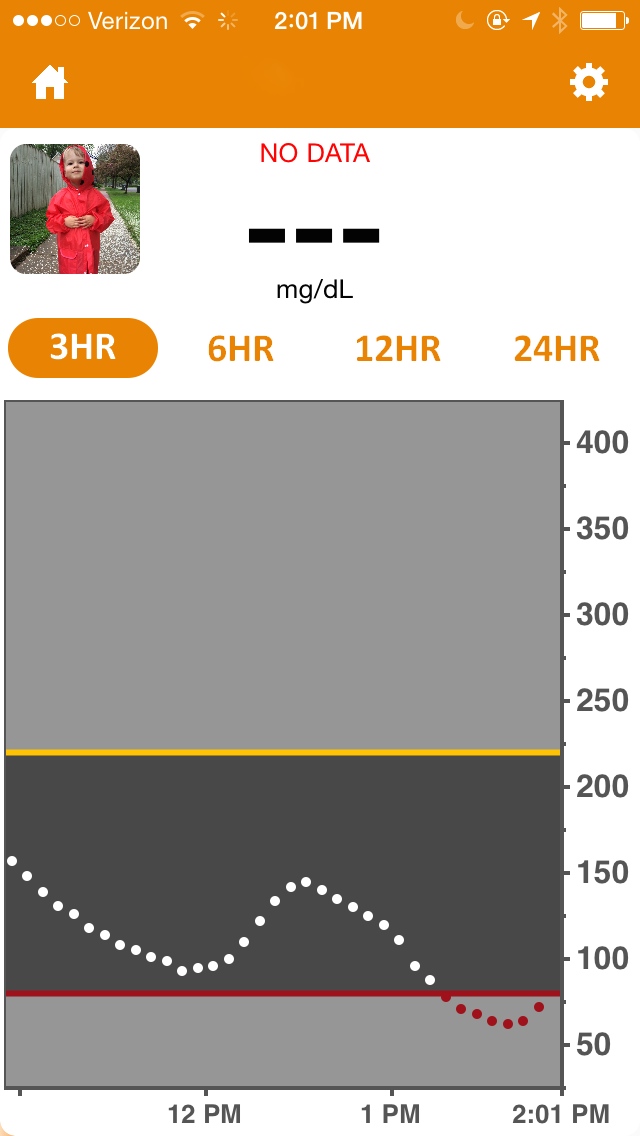
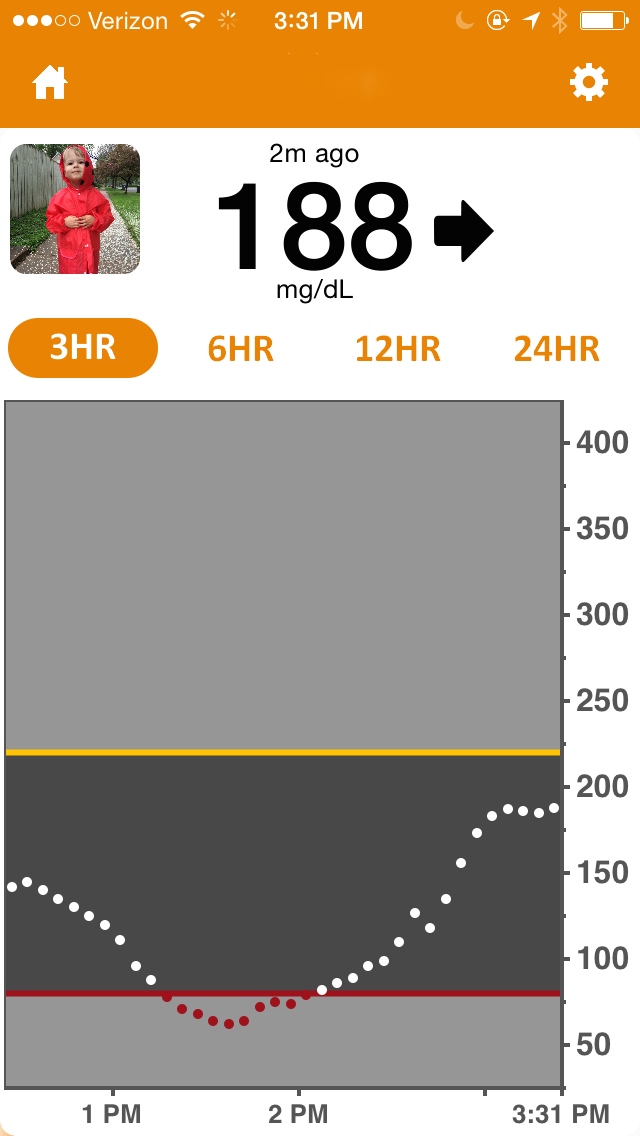
Here’s thirteen ways of looking at Dexcom Share data, with apologies to Wallace Stevens. The images come from one 24 hour period.

IMG_6645

1. Among too many highs from lows.

2. A lesson about banana muffins,

of a mind to never make these again.

3. Pantomime of pancreas is a

slapstick impossibility.

IMG_6639

4. The number is not one, but

frighteningly close. Mother + child

+ pump + glucose tabs = not pancreas

5. The moment before a gut punch

or just after.

6. The line traced in line,

the indecipherable cause.

IMG_6652

7. What do you imagine?

8. Lucid, inescapable numbers?

9. Illusion of perspective—

flown, offline, out of sight?

IMG_6654

10. Euphony, at a line,

a bird to horizon.

11. Not mostly, but once,

a fear usually pierces.

Even when it’s mistook.

12. The insulin or sugar is moving.

IMG_6664

13. It was all night into morning.

It was no sleep into half-sleep.

T1D Helicopter Parents Unite!

I used to teach English at a distinguished college preparatory high school in Los Angeles. Occasionally, the faculty would bemoan the “helicopter parent” after an exhausting and ghastly encounter. For example, a father told me his son, a sophomore in my composition class, could not complete the homework because the son was sad his pet goldfish died. Another mother drove her son’s homework to school after she completed it for him. At my classroom door, in front of his class, she explained he was too excited to do his homework last night after he found out he made the freshman football team.

Even helicopter parents understand that if they always tie their child’s shoe, the child will never learn to tie a shoe. But parenting is a complicated paradox: as a parent, my job is to make myself obsolete. The whole business of parenting is weaning. The process of weaning and independence is  easy to see with young children, when desire precedes ability, and they want to pour the milk or pick out their own clothes. After many days and years of scaffolding independence the hope is my children will get an education and job, be able manage money, make decisions to safeguard their health, find people that make them happy, and join communities.

That’s how the whole plan is supposed to proceed, but the plan requires revision when a chronic disease enters the scenario. Our four year old has type 1 diabetes. Now our job is to aim for all the aforementioned things, but also to daily administer a drug, insulin, which preserves his life, but could take it. In a few years, we’ll have to teach him how to deliver this same drug. We have to teach him how to wear medical equipment (Animas pump and Dexcom) on his body 24 hours a day and how to take care of this equipment. We’ll have to teach him how to heal and advocate for himself when he encounters unkind or ignorant people.

School is starting, so a parade of parents are meeting with educators and administrators about 504 plans, and educating staff on caring for a student with T1D. In her article, “What It’s Really Like To Raise A Child With Diabetes” on The Huffington Post, Lisa Gastaldo explains some of the fears and realities of diabetes care from a parent’s perspective, as well as her history of working well with schools and doctors. I think it’s a great read to pass along to teachers and family members who may not recognize the trials of living with diabetes.

Even people who are in the diabetes community debate when and what a parent’s role in T1D care should be. As CGM in the Cloud and Nightscout emerged and engaged in important debate with Dexcom over moving to an FDA approved platform that enabled sharing of CGM data, people in the diabetes care industry predicted that the helicopter parents of T1D children would be distracted and consumed by the data. We’ve had Dexcom share since June, and have found the opposite to be true. Rather than wondering what our son’s blood glucose is, and texting or calling to find out, we look at the number and move on. We’ve been able to leave our son with family members for the first time since diagnosis. Just this week, both of Henry’s preschool teachers downloaded the app on their phones and marveled at how this continuos stream of information would make monitoring and care easier in the classroom.

Dexcom Share data on follower phone

Dexcom Share data on follower phone

My job is primarily to be a parent, but as I watch my four year old son struggle to put on a pair of pants while holding an insulin pump, I realize my other more arduous job is to be a parent to a person with type 1 diabetes. How long do I watch him try to untangle the tubing from his pants before I step in? To stall, I play a trick on myself and say this is like any other challenge every other kid faces, right? I tell myself only the scenario is different, but then Henry looks at me in frustration. He asks for help, and I can see on his face that he knows this struggle is different, more intricate and undue. There’s no need to say anything in this moment that requires action. Instead, we sit down on the floor, where he can place his pump, and find a new way to put on pants.