Names Are Hard

The ADA’s 2016 Standards of Medical Care in Diabetes recently shifted its language to match the ADA’s position that diabetes does not define people, “the word ‘diabetic’ will no longer be used when referring to individuals with diabetes in the ‘Standards of Medical Care in Diabetes.’ The ADA will continue to use the term ‘diabetic’ as an adjective for complications related to diabetes (e.g., diabetic retinopathy) (54.)'” This means that “diabetes” is now used to refer to the person who has it, instead of “diabetic;” for example, “My sister has diabetes,” not, “my sister is a diabetic.”

The name shift seems simple, but it’s packed with emotions, implications, and for some, even anger. I wrote a piece, Diabetic v. Diabetes, shortly after the ADA published the 2016 Standards of Medical Care in Diabetes, which explained the name change. When I linked to the article on Semisweet’s Facebook page, within seconds, the first comment was, “This is stupid.” Beyond Type 1 featured the article, and it garnered some healthy debate on the Beyond Type 1 Facebook page as well.

Some people see diabetic v. diabetes as splitting hairs or unnecessary political correctness. When I encounter the people who prefer to be called “diabetic,” or at least voice a strong and angry opinion against those asking to be called, “person with diabetes,” I respect their right to be called “diabetic.” In general, it seems these people have lived with the disease for many years— years when the battle was greater because technology wasn’t as advanced and understanding was scarer. Usually, these people are adults; however, children are more sensitive to language, labels, and their implications. In fact, we’re all probably not too far removed from that hateful comment or name someone hurled at us on the playground.

I’m the parent of someone who has diabetes. I couldn’t protect my son from getting diabetes, but I can try to protect him from the implications of being called “a diabetic.” He’s not even in kindergarten yet, and already kids his age have told him he, “can’t eat a certain food because [he’s] diabetic.” He’s been told he can’t play a certain sport because he’s “diabetic.” A neighbor kid didn’t want him in her yard because he’s “diabetic.” He’s brought home treats, like half a muffin or cupcake, from school because he didn’t eat it when the other kids did. We don’t make certain foods off limits, but he’s heard kids his own age tell him what he can’t eat. I wonder what he’s thinking as he watches his classmates eat their treats. He can eat that cupcake or cookie because he has diabetes, but he’s inherited the stereotype that he can’t, because he’s “a diabetic.”

The governing associations like American Diabetes Association are changing their language, and I think this is because our perception and understanding of diabetes is changing. To be “a diabetic” was a certain death sentence 94 years ago. After insulin, to be “a diabetic” meant doctors predicted vastly shorter lifespans; fear and misunderstanding from teachers, relatives, and the larger medical community impacted people’s lives negatively. Women with T1D were told they could not and should not have children (case in point, Steel Magnolias).

In this era of better treatment, people with diabetes can live normal lifespans with fewer complications. As more and more people live longer and better with T1D, we’re starting to understand that living with a chronic disease or condition, like diabetes, has impacts on our emotional health, romantic relationships, and mental health. Having diabetes, means we can talk about this, and if we talk about being “diabetic” versus living with diabetes, there’s a simple paradigm shift at work: a limited life vs. a limitless life.

In images, the paradigm shift looks like this.

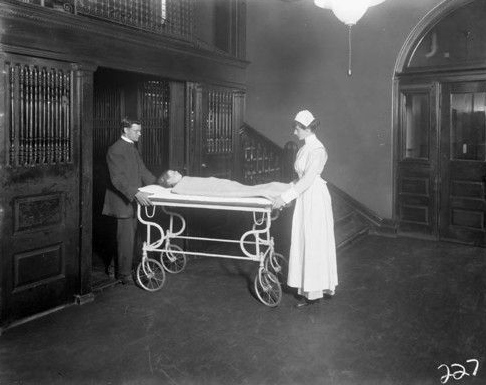
Below is the picture of a child who’s just been given a shot of insulin for the first time in 1922, and he’s starting to wake up from DKA. He was in a Canadian hospital with a ward for diabetic children. Just weeks before, his parents sat at his literal death bed.
library and archives

photo source: Library and Archives Canada

He’s a picture of 4 time Olympian, Kris Freeman. He happens to have Type 1. In the photo, he’s training for another race and is wearing an insulin pump, Omnipod, on his arm.

In both pictures, we can see the life that insulin makes possible, and what’s harder to discern, but still visible, are the implications of being diabetic versus having diabetes.

Being diabetic once meant limitations, and yes, having diabetes requires my son to make sacrifices and take extra steps, but being a person with diabetes puts the focus on personhood. Thankfully, we’re living in an age when having diabetes means it’s a conversation about what we can do instead of what we can’t, and that’s ultimately the difference between diabetes and diabetic.

 

Diabetic v. Diabetes

My son was diagnosed with type 1 diabetes when he was three, so it took some time for us to master a new lexicon that had suddenly become part of our daily language: ketones, glucagon, hypoglycemia, and the list goes on. For the first few weeks after diagnosis we moped around the house, afraid to leave for fear of restaurants and grocery stores, puzzled at how to check a blood sugar in the car with a kid in a carseat. During this time, Henry had lots of questions about his “dia-bee-bees.”

Even in those early days after diagnosis, when someone referred to my son as “a diabetic” it irked me in a way I didn’t fully yet understand. When I broke the news of Henry’s diagnosis to friends and family, I closed the email with, “Henry is a healthy three-year-old boy, who also happens to have diabetes.” In those early murky days, when I was struggling to understand the difference between Lantus and Humalog, it was always clear to me that Henry was a person before he was “a diabetic.”

The 2016 Standards of Medical Care in Diabetes is out, and there’s a huge shift in the lexicon surrounding diabetes. The Summary Revisions section declares, “In alignment with the American Diabetes Association’s (ADA’s) position that diabetes does not define people, the word ‘diabetic’ will no longer be used when referring to individuals with diabetes in the ‘Standards of Medical Care in Diabetes.’ The ADA will continue to use the term ‘diabetic’ as an adjective for complications related to diabetes (e.g., diabetic retinopathy)  (54.)'”

“Diabetic” is an adjective for complications related to diabetes, not my kid. My kid is a person with diabetes. Sure, “person with diabetes” (PWD) is more awkward to say; there’s three additional syllables, and the language is obviously stretching to avoid labels, but the change in perspective can be life-enlightening.

At our house, we used to call the Fed-Ex delivery van “the pincher truck.”

IMG_8536

a pincher truck on delivery

This made total sense to Henry, who came up with the name. One day after he’d spent the night in the hospital, his parents, who’d never physically hurt him, had to hold him down 5-7 times a day and give him shots. Not only did they have to give him the shot, but they had to hold the needle in and count to three just to ensure better delivery of the insulin. Sometimes, they had to do this in his sleep. Then they started taping these pinchers (Dexcom) to his skin, and these pinchers came out of the pincher truck every month or so.

Henry’s almost two years into living with diabetes. He wears a pump and CGM (continuous glucose monitor), and he understands why. He’s also learned that sometimes toys come out of the pincher truck. He’s learning there’s never just one thing in this world. There are people, and some of those people have diabetes.

The first line of the 2016 Standards of Medical Care in Diabetes Introduction reads, “Diabetes is a complex, chronic illness requiring continuous medical care with multifactorial risk-reduction strategies beyond glycemic control. Ongoing patient self-management education and support are critical to preventing acute complications and reducing the risk of long-term complications.” That’s some heavy shit.

Here’s the subtext of that Introduction. Diabetes is a disease and a condition. Diabetes (types 1 and 2) is presenting complexities to a medical system that’s been modeled on fixing acute conditions, not managing a chronic disease across a person’s lifetime, which is why so much of the care, education, and financial burden for diabetes falls on the person and the person’s family.

My son needs strength and confidence to take the extra steps of self-care to manage his disease. At five-years-old, he’s already making sacrifices that are necessary to live a healthy life with diabetes. Those first seeds of strength and confidence come from others seeing him as a person first, not a condition.

Diabetes & Anniversaries

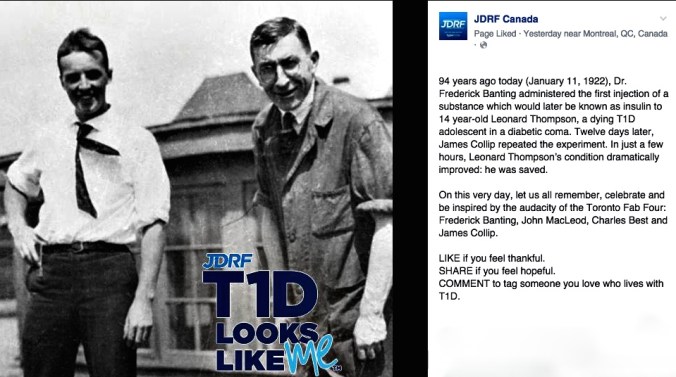
On January 11th, two seemingly unrelated images from the past crossed my Facebook newsfeed. The initial image, from JDRF Canada, celebrated the first injection of insulin given to a human 94 years ago on January 11, 1922. The patient was Leonard Thompson, a 14 year-old boy in a diabetic coma, what was then the end stage of type 1 diabetes. Within hours Thompson began to recover, and the discovery of insulin was immediately heralded as one of the greatest accomplishments of modern medicine. In fact, the The Nobel Prize in Physiology or Medicine was awarded to Banting and Macleod in 1923.

banting best

I’m fascinated with the medial history that surrounds T1D— both in the disease’s enigmatic nature as well as the scientists, doctors, and patients that seek to end T1D.

The second picture that crossed my newsfeed is from January 11, 2014. As a family, we were looking forward to seeing our first movie in the theatre and taking a walk downtown afterword. The songs and characters from Frozen swirled on the screen, and my daughter sat on the literal edge of her seat, holding my hand and inhaling with delight. Henry collapsed into his papa’s lap, and barely moved during the show. Since this was his first time in a theatre, I thought that maybe the light and sound were disorientating to him. I tried to make light of his grumpiness, so I took a picture of him.

movie fro

January 11th, watching Frozen;   diagnosed with T1D on March 6th

Now when I look at the picture, I see his flushed cheeks and puffy eyes, which happen when he’s had a persistent high blood sugar. The small Sprite in the cup-holder (probably the second or third soft drink he’d ever had), haunts me, and  I understand why he was lethargic during the movie and walk.

Around the time of the photo, the only symptoms he showed were irritability and lethargy. About three weeks later, my mother visited and commented on the heaviness of Henry’s morning diaper. I said, “I think he might have diabetes.”

When I said that, I didn’t really think Henry had diabetes, but I must have said it to voice an irrational fear, so the absurdity of the worry would become a talisman against its reality, like knocking on wood.

Parents of young children with type 1 diabetes often talk about the last picture of their child before diagnosis, noting the bittersweet moment. Usually, the photo shows some evidence of weight loss or lethargy, so parents beat themselves up for not knowing what was going on. On the other hand, there’s great liberty, because they didn’t know what they didn’t know— the ceaseless, worrisome nature of type 1 diabetes— a paradox  photo of a really sick kid in a last moment of joyful blindness.

When both these pictures crossed my newsfeed on January 11th, my first thought was thankfulness. How little time has actually passed between these two moments, but how many lives. Henry’s great grandfathers were born before the invention of insulin, and it’s only because of insulin that Henry’s alive.

In the early days after a T1D diagnosis, there’s shock and sadness, but there’s also an awareness of the great heritage of suffering and success that comes with T1D. I hope we’re at a moment in T1D history when the burden of care improves and the instance when some unlikely, scrappy doctors and scientists stumble onto the next breakthrough.


Q. How Can Doll Toys Make People Angry? A. Add Diabetes.

Right before the new year, my Instagram and Facebook blew up with images of young girls peering longingly into American Girl Store windows at this.

IMG_8446

a diabetes care kit from American Girl

Initially, this was a feel-good story. The American Girl company responded to a petition created by Anja Busse (11 when she started the campaign two years ago) for a “Diabetic American Girl.” There’s a Facebook page to support the idea and the petition garnered over 4,000 signatures. And at the start of 2016, American Girl responded by releasing its diabetes care kit. 

How could this story go wrong? A young girl became an advocate and a company responded with an ethical decision that could help potentially thousands of children feel a little bit better about living with a chronic disease. But then the ignorant trolls.

screenshot_2016-01-03-08-32-51This is another example of someone in the fitness community not understanding that type 1 and type 2 are different diseases. To Vinnie Tortorich’s credit, he’s now educating himself on the fact that type 1 is an autoimmune disease and is unrelated to lifestyle and diet, unlike the CEO of CrossFit.
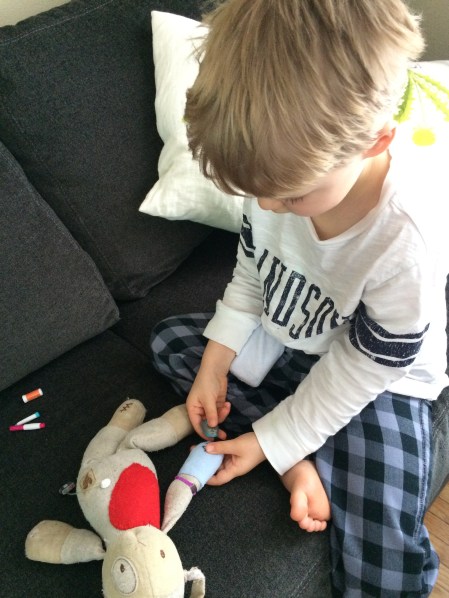
Kids who live with type 1 diabetes encounter many hardships, and aggressive ignorance by educated adults is harmful. Unfortunately, the only way to correct a lack of knowledge is to speak up during a diabetes dust-up.

The American Girl diabetes care kit is a victory. If a major corporation like Mattel (which American Girl is a subsidiary of), can get diabetes type 1 and 2 right, then so should CrossFit, the CDC, and anyone who shares a public opinion that expresses shame and blame over understanding.

IMG_8443


Diabetes & New Year’s Resolutions

I really enjoy the first week of the new year. The glut of the holidays is packed away, and while there’s reflection on the past, there’s more focus on the upcoming year. I work in academics, so the semester has yet to start, and our small town is usually covered in about a foot of snow. It’s quant, so this seems like the perfect time to reflect and plan. However, I’m not someone who makes New Year’s resolutions. In general, I believe that if there’s something I want to change or start, any random Thursday is just as good as New Year’s.

IMG_8402

a new year walk in the snow

Yet, type 1 diabetes has made me reconsider many assumptions and mores. The possible wisdom in establishing some resolutions at the start of the new year is just one of them. On her blog, Inspired by Isabella, T1D mom (and mother of triplets!) Kristina Dooley, wrote a post called “Losing Sight” that bravely discusses some of the biological stressors of being a T1D caretaker to a young child. Almost two years into the life of a d-mom and I can feel the effects of chronic sleep deprivation: foggy thinking, an increasing obsession with coffee, and higher stress levels.

Diabetes (both 1 and 2) is insidious for hundreds of reasons, but at the start of the new year, it seems that T1D is particularly cruel because there’s never a chance to regroup. Once that medical professional says “your child has type 1 diabetes” there’s no off-ramp. Instead, the person living with T1D, and to a smaller extent, his or her family, is running a marathon. For life.

We’ll look for the shady spots, like a three hour window with in-range steady blood sugars.

Maybe the start of 2016 is another good moment to rest. We don’t have much time before we’re back in the slog, so I think a few resolutions might help reframe our 2016 leg of T1D marathon: more protein, more sleep, and less worry about what’s beyond our control. On second thought, these are pretty lofty goals. I’ll settle for more sleep.

Richard’s Diagnosis Story

Diagnosis stories are powerful teaching tools that help people learn to recognize the symptoms of type 1 diabetes. For the person diagnosed with type 1 diabetes, a diagnosis is the day his or her life changes and goes forward. Semisweet is sharing “Richard’s Diagnosis Story” in his own words. Richard has been living with type 1 diabetes for over 70 years. In 2006 he joined the diabetes online community, where people were fascinated to hear Richard’s story of living with T1D in the 1940s and beyond. In 2010, Richard published his autobiography, “Beating The Odds: 64 Years Of Diabetes Health.”

Richard, diagnosed at age 6, September 1945

I was born in 1939, in Roanoke, VA, and I had several illnesses before my fifth birthday: three different kinds of measles and my tonsils removed. When I was five I had chicken pox and mumps, and while recovering I began showing the classic symptoms of diabetes— excessive peeing and drinking so much water. My parents took me to three different doctors, but they did not recognize my symptoms, so there was no diagnosis. I lost my appetite, and refused to eat. I just wanted to drink.

One doctor prescribed a tonic that was supposed to restore my appetite. I still remember the bad taste and tall glass bottle filled with dark brown liquid. It was like the snake oil medicine that we have read about from the past. The tonic did not help at all. It probably made my condition worse because it contained sugar. By the time we saw a fourth doctor I was very weak, and had lost a lot of weight. My ribs were very noticeable when my shirt was removed. The fourth doctor recognized my symptoms, and took a blood sample in his office. The sample was sent to a lab, and we waited a few days before returning to his office for the results.

His office was on the second floor of a building on Main Street in Salem, VA, and I struggled to slowly walk up the long flight of stairs. My father was carrying my three year old sister, but I was too big to be carried. In the doctor’s office, my mother and I sat in chairs while my father stood behind us, still holding my sister. I do not remember the doctor’s face, or his words, but I’ve never forgotten my mother’s pale and frightened face. In September 1945, a few days after my sixth birthday, we were told that I had sugar diabetes. I was hospitalized the next day, and don’t remember much about the stay, except for the injections and the blood that was collected. Insulin, taken from pigs or cows caused me to gradually regain my appetite, and I stopped losing weight. By the time I was home, I looked like a human being again, and my strength was very much improved.

10258864_1238484469500822_1295893666899560174_o

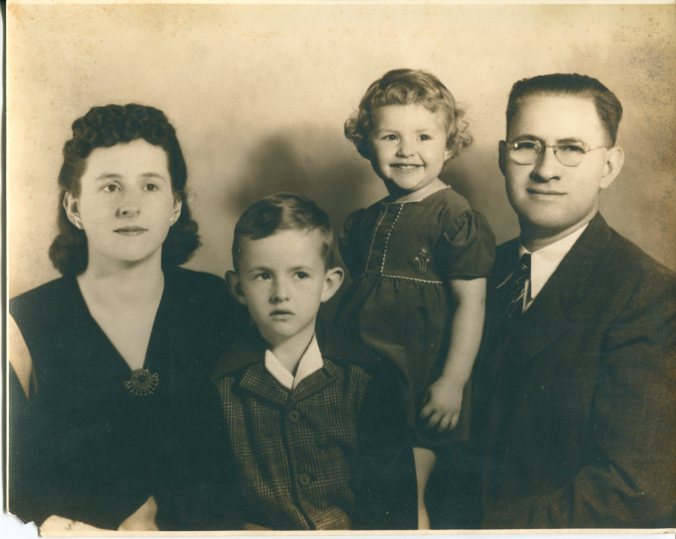
Richard and his family a few months after his diagnosis

While in the hospital, I was treated by Dr. Davis and he became the doctor for my whole family. I saw him every six months, and he took blood samples, testing them in his office lab while I waited. My blood sugar was always high, but I don’t recall him ever mentioning numbers. We were not concerned though because we did not know about the complications that might occur with my eyes, kidneys, and other body parts. One shot per day, one urine test, large portions of food, and no worries. Ignorance was bliss.

There were no meters for testing blood sugar at home until the 1980s, almost forty years after my diagnosis. We tested my urine at home, every morning, but the procedure for doing that was very awkward. The first thing I did each morning was to pee in a cup. Some Benedict’s solution was placed in a large test tube, and several drops of urine were added. The test tube was placed upright in a container of water on our stove. When the water had boiled a while, the test tube was removed, and the color of the solution was observed. The original color of the Benedict’s solution was blue. If the solution containing the urine was blue, after boiling, then there was no sugar present in the urine. If sugar was present in my urine, then there would be colors: green, yellow, orange, brick red, or brown. Green showed a low amount of sugar, brown showed very high sugar.

944912_1236570436358892_5889406186695641956_n

testing blood sugar with Benedict’s solution

It was nice that there was only one injection each day before breakfast, but there were no fast and slow acting insulins, so control of my blood sugar levels was not good at all. The animal insulin was a 24 hour insulin, so the morning urine test result determined the dosage, but urine tests do not approximate blood sugar well. The glass syringe and metal needles were kept in alcohol, and sterilized with boiling water on the stove once each week. We had our own well, and the water contained limestone deposits. After boiling, there was a white film on the needles and syringe, so we had to use a whetstone to remove the deposits. The limestone frequently clogged the insides of the needles, so we had to push a small wire through the needles to unclog them. If the deposit was not removed it was difficult to push the needle into my skin. The needles were almost three quarters of an inch in length. I was supposed to push the needle into the muscle on top of my legs, or on my arms. My father gave me my injections until I was ten.

During the night I would sometimes have hypos. Some of those hypos became seizures. I would thrash around during my sleep, my teeth clinched, my muscles would become drawn, and I was almost unconscious. Mother poured small amounts of the sugar water they kept nearby on my lips, until I had enough in my mouth to partially awaken me. Then I drank the liquid more freely. I was always drenched with sweat, and very weak after a seizure. My body was sore the next day and the sugar water caused my urine test to show high the next morning. I continued to have seizures for many years, but they occurred less frequently when I was older. There was never any effort made to call an ambulance. Perhaps it was because the nearest hospital was at least 10-15 miles from our house, and I doubt that the paramedics in the ambulance had glucagon injections. Home care was probably the best solution. I think my mother saved my life many times during the years I lived at home.

Dr. Davis told us that I should not eat sugar, but no other instructions about an appropriate diet were given, so we didn’t know about carbohydrates. We lived on our little ten acre farm, and we had cows, chickens, pigs, and a horse. There was a very big garden, and an orchard. We bought very little food at the grocery store, so processed food was rarely part of my diet. Our own milk, eggs, vegetables, and fruit were readily available. We had meat from the chickens and pigs. Mother canned food each summer and fall. I helped my father with the farm work, and I was very hungry, so I ate big portions at every meal. I ate all the same food that my parents and sister ate, except items containing sugar. Mother used saccharin to sweeten the pies, cookies and cakes that she made for me. I ate lots of bread, potatoes, and other things that were not good for me, but we thought all foods were okay, if they did not contain sugar.

My parents did the best they could for me during my childhood and Dr. Davis gave no instructions that helped. We did not know there could be potential problems, and I led a rather normal day to day existence. There were no health problems with my diabetes throughout my childhood, despite my very irregular blood sugars. I have often wondered why I did not have DKA back then. Was something protecting me? All the fast acting carbs I ate each day (without correction boluses like I take now) must have kept my blood sugar very high. I’m sure my parents were devastated by my diabetes, and not knowing how to care for me. My parents raised me in much the same way that they were raised in their mountain homes. They were raised on farms, and they loved that kind of living.

When I talk to parents of T1D children diagnosed today, I advise them to join online diabetes support groups for parents. Children with Diabetes, created by Jeffrey Hitchcock, and the many parents’ support groups on Facebook are very good sources of advice and information for parents. Getting support from experienced parents can help so much! There are books that are available, but I think the online community is best. Having T1D children meet other children in their communities is a very good idea. Diabetes camps in the summertime are an excellent idea. Attending the Friends For Life conference in Orlando, FL is another source that I have seen work so well with children who are type 1.

10903837_1036689413013663_7375763260254691701_o

Richard at 76, having lived with T1D for 70 years

If you’d like learn more about Richard’s life with type 1 diabetes, then check out this video interview where Richard shares his experiences with Daniele Hargenrader. Richard was also interviewed about living with T1D for over 7 decades on Diabetes Mine. Richard will also be a speaker at the 2016 FFL conference in Orlando, FL. You can follow Richard on Twitter @Richardvau157.

‘Tis the Cookie Season

A few weeks after starting Kindergarten, I noticed a blue ring around my non T1D daughter’s mouth. When I asked her about it, she quipped, “Brain’s birthday,” which I later found out meant that with 24 kids in class over 36 weeks of school means  a birthday celebration every two weeks. Plus holiday parties. Even before type 1 diabetes entered our family, we’d reserved sweet treats for special occasions. If a child asks for something like a grocery store cupcake, we generally respond with, “It’s probably not a good idea for anyone to eat that.” Sure, a grocery store cup cake once in a while is fine, but treats like this seem to have permeated childhood.

I think most parents aren’t thrilled about the idea of their kids eating this kind of food. Now imagine your child has type 1 diabetes.

Generally, this scenario can go two ways. The child with diabetes is told he or she can’t have the treat by a parent volunteer or teacher, so then the kid gets to eat nothing (or sugar-free Jell-O) while watching his or her classmates enjoy deli cupcakes or cookies. In the second scenario, the child gets to eat the treat, because children with type 1 can eat anything, but it’s just impossible to get synthetic insulin to match the metabolic challenge that is a partially hydrogenated, shelf-stable, steroid level sugared, red dye #3 filled deli cupcake. So the kid with type 1 eats the cupcake, and has an elevated blood sugar for several hours, which is difficult to bring down, and during this elevated blood sugar, the kid feels foggy, tired, achey, thirsty, and upset. So, what’s the right choice? There isn’t one.

As parents, we’ve fallen on both sides of the sugar divide. We’ve let our son eat cupcakes at birthday parties and battled 300-400 blood sugars into the night that don’t seem to budge no matter how much insulin we pour on it. In other instances, we’ve brought our own low carb “treat,” avoided events, or distracted him. Moments like this reveal that diabetes is often a choice between bad and worse.

As we enter another season of sweets, we’ll fall on both sides of the sugar divide, and recognize that when a parent has to choose between bad and worse, it’s a pretty lousy feeling.

This week we were at a birthday party, for which we’d planned all day.  We knew the carb counts of what would be at the party. We’d purposefully kept our son’s carb intake light in preparation for the party. We had a rockin’ prebolus and temporary increased basal. At the dessert buffet, we let Henry choose anything he wanted to eat, and he ate gold fish, clementines, a cupcake, pretzels in a pool of white chocolate, peanuts covered in chocolate, and pop corn. He selected almost everything except for this cookie, but he kept circling back to it during the party.

cookiesjpg

During his third trip to the table, I walked over to talk with him about it. He said, “Mama, look at those cookies.”

“I know,” I said. “Those cookies look really silly. I think they were made to look like a Dr. Seuss character.”

“Yeah,” he said, and he just stood there a long time. A long time. Not taking one. Not asking for one. Just looking.

“What do you think they taste like?” he asked.

Not wanting to pile more sugar on what was a high and rapidly rising blood sugar, I said, “I think they taste sour.”

As these words were coming out of my mouth, I knew they were simultaneously the easy and worse choice. We never tell Henry that he can’t eat something because he has type 1 diabetes, but in a way, I just did.

He walked away from the table and played soccer with a balloon as we helped clean up for the next hour. We headed over to our hosts’ house, where all the cookies and party treats followed. We ordered Chinese food for dinner, and learning from our previous Chinese food experience two weeks ago, we went bold with insulin and ran a combo bolus coupled with an increased basal. About 45 minutes after dinner, Henry’s blood glucose was 70 with 1.39 units of insulin on board.

“Hey Henry,” I asked, “Do you want to try one of those cookies with the silly eyes?”

“Yeeeeeesssss,” he shouted, and ran to the kitchen.

He came back with the cookie accomplished, and while dusting the crumbs from his thumbs on his shirt, he said, “Hey mama, those cookies don’t taste sour.” He said it with this kind of crazy half-smile that told me he was dubious about sour cookies from the get-go. Smart kid.

Team Pancreas: Caregivers Matt & Rachel

How would you describe your child’s condition?

Matt: Henry has type 1 diabetes. This means that his entire life is centered around the fact that his body does not produce the insulin he needs to process glucose, so we check his blood sugar about ten times a day by poking a small needle into his finger and adding that drop of blood onto a meter that tells us what his BG (blood glucose) is. Depending on what the number is, we give him insulin, sugar, or wait. This means that we deal with low blood sugars, which are potentially, immediately, fatal; high blood sugars, which can have drastic, long-term consequences for his life; or “normal” blood sugars, which help keep him healthy. We get up every two hours every night to help maintain his blood glucose. Two weeks ago, Henry looked at me and said, “Diabetes is a hard life.” I agree.

Rachel: Our son, Henry, has an autoimmune disease, type 1 diabetes. Something triggered his beta cells to stop producing insulin, so he must take subcutaneous insulin for the rest of his life, test his blood glucose 8-12 times a day and always account for the carbs he eats with insulin. There’s never a break from type 1 diabetes, because the person with diabetes or the person’s caregiver/s is trying to replicate a job the pancreas once did.

What care for your child is required, and how do you and your partner divide this care?

Matt: We make sure that he gets enough insulin to cover the carbs (sugars) he eats so that his blood glucose does not get too high and cause damage to his organ systems. We also make sure that his BG does not drop to a low level that could result in seizure or death. We count all of the carbs he eats and program his (miraculous) insulin pump to keep him in balance. We also change his pump site every two to three days, as well as his constant glucose monitor (CGM), another amazing device that keeps us updated on an estimate of his BG. Rachel definitively manages the difficult logistics of this care. She deals with insurance companies, refills at the pharmacy, and talking to the reps at Animas (insulin pump) and Dexcom (CGM).

Rachel and I both deal with the daily stresses of handling diabetes. We both count carbs, take BG readings, get up in the middle of the night and evenly split the duties of changing Henry’s pump and CGM sites. Henry has developed a pretty nasty allergy to the tape that holds both of these machines onto his skin, so we have to take a lot of precautions to make sure that his exposure to them is minimized. Rachel reached out to the diabetes online community and found people who helped us come up with solutions when our docs had basically given up and asked us to go to multiple daily injections.

The best balance that we have, in terms of day-to-day care, is that Rachel is very good at keeping track of what Henry needs medically and practically; she amazes me with how much she has learned about diabetes and its care—  and I am helpful in the ways that I try to create some distance from a life with diabetes and a “normal” life for Henry. I’m probably more likely to encourage us to get ice cream or wait to change a site— this balance only functions because of how hard Rachel works.

Rachel: In the wise words of Kenny Rogers, “Know when to hold ‘em, /  Know when to fold ‘em / Know when to walk away / Know when to run.” I know when to hold ‘em, which comes in handy with the rigor and attention counting carbs and dosing insulin requires. Matt knows when to fold ‘em and let Henry live the life of a five year old with birthday parties, extra ice cream, and a day longer with a site. Henry will need both of these skills as he learns to live and manage his diabetes. Balancing diabetes is an art and a science, so I’m the science while Matt’s the art. Matt and I both know when to walk or  run away from a negative comment, failing site, or excessive carb scene.

IMG_7969

Team Pancreas

How has being a caregiver changed your relationship?

Matt: I don’t think it’s changed us fundamentally. We don’t always agree about everything to do with Henry, but we always talk about why we think a certain action is best in the certain moment. Ultimately, we are both focused on making sure that Henry is safe and protected. Chronic conditions are definitely an added stressor, and I’m sure that we get a little snappier at 3:00 in the morning, but we are both committed to each other and to caring for Henry.

Rachel: A lot, but a little. A lot because we are now caregivers for our son, who has a chronic condition, but not a lot because we decided to become partners and then parents together long before diabetes entered our lives, so we’ve mostly figured out how to handle stress and difficulty. A day to day difference is struggling with time, because everyday actions, such as preparing for a trip or eating at a restaurant, are now more complex and require discussion, preparation, and planning. We have to depend on each other more.  

Describe a caregiver technique you and your partner do differently.

Rachel: We both do really hard things. For the past 18 months I’ve put in Henry’s pump site, which feels like I’m stabbing him with a giant needle. Henry anticipates site changes, and it’s just awful to know that I’m causing my child physical pain, even if it’s for treatment. When Henry asks something like, “Will I have diabetes when I’m a grown up?” Matt can answer this question honestly and have Henry laughing within a few minutes, whereas I have to leave the room because I don’t trust myself to answer without getting choked up.

Matt: We have split things up, but we talk or text at least two or three times a day about his care when we are both at work. Changing the site of Henry’s pump is stressful because of the precautions we have to take with his skin and because he dreads them. We put Lidocaine on his skin to decrease the pain but they still worry him. I prep the area on his skin and get the pump primed to administer insulin and hold him while Rachel actually inserts the pump.

In twenty words or less, describe your partner’s caregiving superpower.

Rachel: Matt’s superpower is levity that inspires patience and laughter, needed in the shadow of a wrong number at the right moment.

Matt: Rachel’s superpower is her love for Henry and how this gives her a laser-like focus on keeping him alive.

Tom Hanks Sausage Links! a.k.a.: Co-Parenting Children with T1D

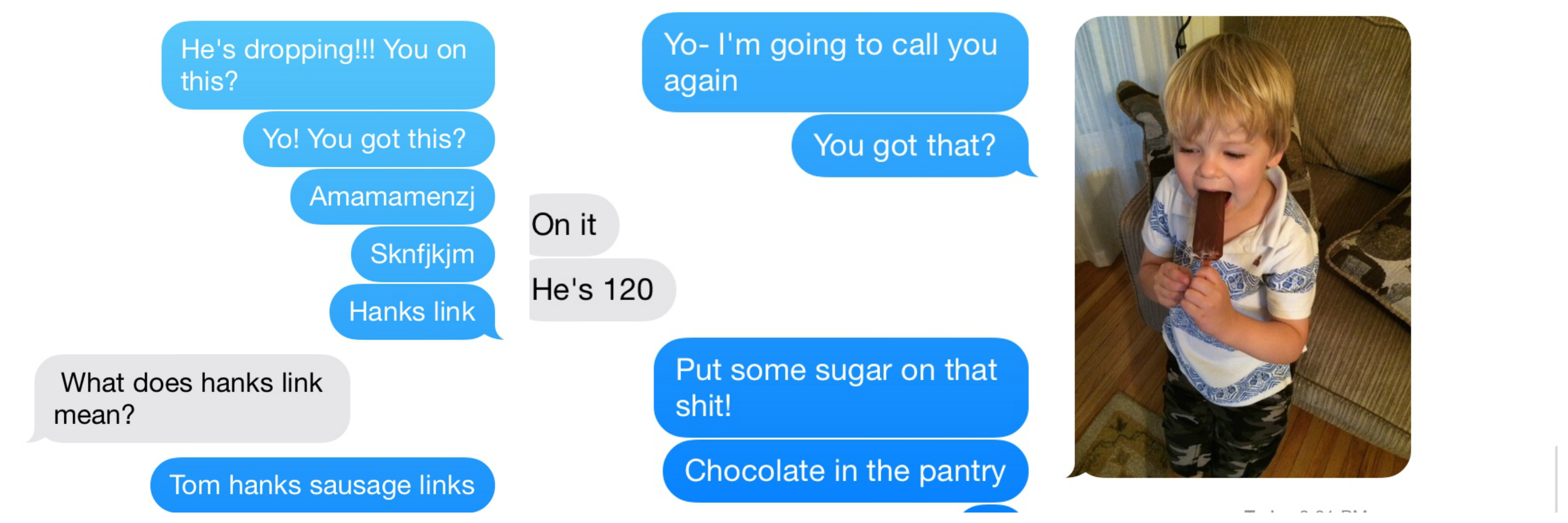
Presenting, in comic strip form, texts with my husband and fellow co-caregiver, wherein I just text letters to get his attention about a rapidly dropping low blood sugar, and autocorrect adds title inspiration: hanks link.

Tom Hanks

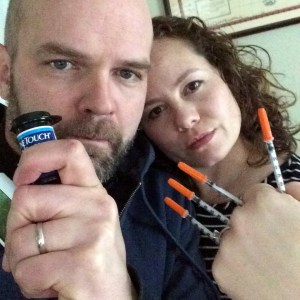
Parenting a young child with diabetes is a mixture of all-the-time-low-level-anxiety and anger/worry/warrior/defeated super vigilance, so it’s better to have two capable people on the front lines. My husband and I have a complementary approach to care; I’m the letter of the law and he’s the spirit of the law, and for our son to balance the burden of T1D across his lifetime, he’ll have to be both.

One random morning in March almost two years ago, my husband and I were learning to test each other’s glucose, but now we’ve tested Henry’s glucose over 6,000 times (20 months X 10 or more times a day). Every two days we change a site for his insulin pump and every seven days we insert a CGM (constant glucose monitor). About every 45 minutes, one of us looks at our phones to see where his blood glucose is, and every time we ever give him anything to eat or drink for.the.rest.of.his.life, we calculate the carbs and apply insulin or sugar.

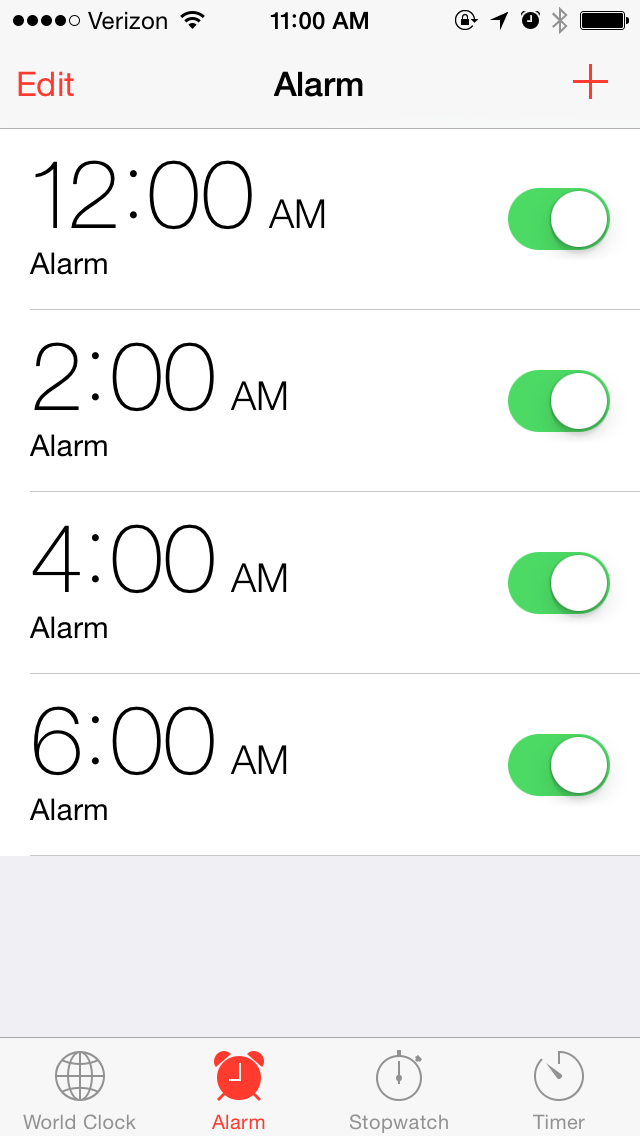
I’d do this for Henry for the rest of his life if I could, but I know that living a life of independence, freedom, and self-sufficiently means I’ll teach Henry to care for his diabetes little by little, and that crushes me, because right now my husband and I are working really hard to replicate a pancreas, and it takes sleep,

my nightly alarms

my nightly alarms

brain-space, sacrifice, hauling gear, literal hours from our day, money, and focus. Type 1 diabetes is a heavy burden to share, but it seems insurmountable to carry alone.

November is both Diabetes Awareness Month and National Family Caregivers Month. Before my son was diagnosed with diabetes, I thought caregiving was typically something the younger did for the old. In it’s more raw version, caregiving reverses its normal evolution and becomes something the older does for the younger, either for a lifetime or a portion of a lifetime. Now that we’re parents who are also caregivers, I see how many other parents share this joint occupation, so this November, Semisweet will be highlighting stories of parents who are caregivers.

To kick off the discussion, please check out this great video, “I Am the Pancreas,” by Rick Suvalle, dad of two T1D kids. He followed his son and daughter around for a few days with his iPhone to show what caring for T1D kids is like. To the parents of young T1D kids: we are the pancreas!

Diabetes Awareness Month Begins!

About two years ago, I was celebrating a lack-luster birthday. My son had been lethargic for a couple of weeks. He was peeing through diapers, drinking a lot, and he was very cranky. After bedtime, a friend stopped by our house for a birthday toast. What should have been a pleasant conversation devolved into me telling her how I’d scheduled an appointment for my son the next morning because I thought he had diabetes. Earlier in the day, my mother-in-law called to wish me happy birthday, and I quickly switched the topic to Henry’s strange symptoms and my suspicions of type1 diabetes. I look back at these moments and am thankful I acted so quickly; however, now I realize how little we knew about living with type 1 diabetes. Twelve hours after my friend left, my husband and I were in the car with our three-year-old son on the way to the major children’s hospital in our state.

Now, I’m really aware about diabetes, but here’s the paradox about awareness: you can see outlines of what you don’t know. I don’t know how Henry is going to handle T1D in school. I don’t know how his teachers will handle managing diabetes in a classroom as we change grades from year to year. I know Henry can and will rebel against T1D in his teen years, and I don’t know how to walk that with him yet. I wonder how T1D will affect his major friendships and relationships, and potential children, who would have about a 10-20% chance of developing T1D.

November is Diabetes Awareness Month, and November 14 is World Diabetes Day, which is celebrated on the 14th because it’s William Banting’s birthday. Banting and Best co-discovered insulin in 1921. Diabetes Mine lists the many social media campaigns planned for this November. Semisweet is planning some guest blogs and will be participating in Project Blue November’s Instagram campaign this November. We’ll see you here and in pictures.

Now that we’re recovering from Halloween, we’re kissing diabetes goodbye.

#kissdgoodbye & Halloween via Dexcom

#kissdgoodbye & Halloween via Dexcom