2nd Diaversary: 731 Days of Living with T1D

I like my birthday less than I used to. Of course it still happily marks another year of life to celebrate with friends and family, but March 5th also marks the last day my son would ever not have type 1 diabetes. On March 6, 2016, my son has been living with (diagnosed) T1D for 731 days (there’s a leap year in there), roughly 37% of his life.

IMG_8555

Semisweet Soap (0 carbs)

We haven’t figured out how to mark or celebrate his diaversary, a neologism for the anniversary of a diabetes diagnosis. I think we’ll wait for Henry to take the lead on this. However, I’ve been reflecting on this upcoming date for a few weeks now. Moments like this are mile-markers because they disrupt the routine of counting carbs, insulin delivery, and correcting highs and lows. If I think about the preponderance of diabetes care all at once, it’s overwhelming, so the task-to-task perspective allows me to get up each day, put my boots on, and do it all again. Yet, around these mile-marker moments, I usually peek out the window at the vast appalling and inspiring mountain range that is T1D management.

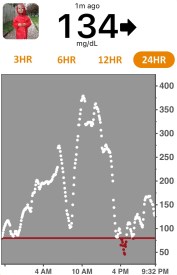
On March 1st, I recorded all my actions related to T1D care. Here’s one day of T1D care. It’s only one day. Some days are better. Some days are worse. We’ll do it all again tomorrow.


KEY

basal= background insulin being delivered by pump

bolus= a larger amount of insluin delivered at meal and snack to cover carbs

BG= blood glucose

CGM= continuous glucose monitor, provides an estimate of Henry’s blood glucose every 5 minutes

Dexcom Share allows us to see blood glucose values on our phones

ezBG= pump function calculates how much insulin to deliver to correct a high BG

IOB= insulin on board, the amount of insulin that has been administered and is still circulating


12:03 a.m.- check BG by blood, 74 with an arrow down to the side, half a juice box

2:00 a.m. – wake up to alarm, check BG on CGM, 147 with an arrow straight across go back to sleep

5:00 a.m.- wake up to alarm, check BG on CGM, 220 with an arrow straight across, so check BG by blood, it’s really 309, give 1.25 units of insulin, go back to sleep

7:00 a.m.- wake up to alarm, check BG on CGM, 137 with an arrow down to the side, so I get ready for work

7:30 a.m.- check BG by blood, 130, while Henry is still asleep, prebolus 1.5 units of insulin for a breakfast of 25 carbs

7:35 a.m.- help Henry get dressed so that the pump and CGM sites stay secure

7:55 a.m.- Henry eats breakfast, a low carb, sugar free muffin and a scrambled egg with cheese

8:35 a.m.- check BG on CGM 107 down to the side, get d-bag ready for school

9:05 a.m.- drop Henry off at preschool, get CGM on Wi-Fi, check BG by blood, 210, give .15 units of insulin to correct high

9:15 a.m.- listen to a diabetes podcast during morning email and class preparation

10:08 a.m.- text from Henry’s preschool teacher/s: Did another ezBG, I look at BG remotely, 320

10:59 a.m.- right before teaching, look at BG remotely, still 320

11:17 a.m.-text from Henry’s preschool teacher/s: We did another ezBG at 10:30 and it gave another .3. He had 1.07 IOB at the time. 

11:45 a.m.- Husband calls during class, saying he went to check on Henry, who has large ketones. Pump said to give 6.6, but this would be way beyond the most insulin Henry’s ever had at once, and it made my husband nervous, so he gave Henry 5.6 units of insulin to correct for large ketones and cover his lunch of grilled cheese and tomato soup. 5.6 is the second highest amount of insulin Henry’s ever had on board.

12:01 p.m.-look at BG remotely, 329 with an arrow up at the side

12:15 p.m.- listen to voicemail from drugstore about prescription problem with test strips

12:45 p.m.- while on a way to a meeting, read text from husband: I called the school and told them to go ahead and give the additional unit I was worried about, look at BG remotely, 363 with an arrow up at the side

1:15 p.m.- during meeting, unsuccessfully try not to think of Henry’s ketones and blood sugar

1:53 p.m.- text from Henry’s preschool teacher/s: We gave another unit and are continuing to push water. Will have cheese stick and beef stick for snack, husband texts back and asks that Henry be given 1 additional unit of insulin to help clear ketones.

2:30 p.m.- look at BG remotely, 263 with an arrow straight across

2:33 p.m.- look at BG remotely, 260 with an arrow straight across

2:38 p.m.- look at BG remotely, 260 with an arrow straight across, realize I have to stop obsessing and get some work done

3:08 p.m.- look at BG remotely, 141 with double arrows down, which means Henry’s BG is falling faster than 3mg/dL per minute, text to his teacher/s: Now he’s falling fast! What’s his real BG and how much IOB? 

3:16 p.m.- look at BG remotely, 111 with double arrows down, call classroom and talk with student worker who tells me that IOB is 1.16, I tell her to give Henry 2 glucose tabs, text husband this information

3:25 p.m.-look at BG remotely, 95 with double arrows down, I tell myself I am a logical person, that the sugar will do its job and the CGM is lagging, so he’s probably leveling off, not spiraling down

3:29 p.m.- text from Henry’s preschool teacher/s: 97 and .92 IOB, gave two tabs 15 min. ago, CGM says 84 with double arrows down

3:58 p.m.- look at BG remotely, NO DATA

4:16 p.m.- my phone buzzes with a Dexcom alert, I check, says he’s 64 with an arrow straight across

4:31 p.m.- my phone buzzes with a Dexcom alert, I check, says he’s 64 with an arrow straight across, then Henry walks through the door with his papa, who said his BG by blood was 112

4:46 p.m-. my phone buzzes with a Dexcom alert, I don’t check, knowing it’s still catching up form the fast drop

5:40 p.m.- check BG by blood, 95 and prebolus 1.4 units of insulin for a dinner of 40 carbs

6:10 p.m.- during dinner my phone buzzes with a Dexcom alert, CGM says BG is 74 straight across

7:00 p.m.- check BG on CGM, 121, an arrow straight across

7:28 p.m. – help Henry change out of his clothes and into his pajamas to preserve pump and CGM sites

7:32 p.m.- check BG by blood, 111, give .55 units for a high protein bedtime snack of 11 carbs

7:40 p.m.- add some new basal times and programs to avoid nighttime highs, which have been more or less constant for the past few days

7:56 p.m.- check BG on CGM, 160, an arrow straight up

8:56 p.m.- check BG on CGM, 157, an arrow straight across

9:32 p.m.- check BG on CGM, 134, an arrow straight across

9:46 p.m.- silence reminder alarm from pump to check BG 2 hours after insulin delivery

10:10 p.m.- check BG on CGM, 181, an arrow straight across

10:39 p.m.- check BG on CGM, 177, an arrow straight across, decide to check BG by blood, 209, give .7 units of insulin

11:32 p.m.- check BG on CGM, 168, an arrow straight across

11:42 p.m.- check BG on CGM, 158, an arrow straight across, set alarm for 12:40 a.m., 3:00 a.m., and 6:00 a.m.
FullSizeRender (5)

today 


#Teampancreas

T1D is a family disease. Our family has learned how to recognize and treat a low blood sugar. We make decisions about what to eat and when. We monitor blood sugars 24 hours a day. Henry’s sister also helps. She watches his numbers while they play and distracts Henry during site changes.

Part of Henry’s pancreas may not be functioning, but he’s got a village of support replicating (as close as humanly possible) what his beta cells once did.

Beyond Type 1 is celebrating #Who Do You Love? on their Instagram wall. Of course, Ava is a great addition to #teampancreas.When it comes to diabetes, there’s not a lot to celebrate; however, the way family and friends rally with support and understanding is something to honor.

T1D, Tummy Bugs, & Time

About this time last year, Henry was taking a bath when he threw up. Matt began checking for ketones and calculating how much insulin he could or couldn’t give to a kid with a tummy bug, while I ran out to the grocery to purchase lots of soda, popsicles, and jell-o with sugar.

Tummy bugs are tricky with T1D. Ketones develop with sickness and when there’s not enough insulin to break down the glucose. In someone with T1D, what clears ketones is insulin and massive hydration, but when someone with T1D is vomiting, the person can’t keep the fluids down so that insulin can be administered safely. As ketones and dehydration increase, probably coupled with a low blood sugar, the likelihood of DKA
(diabetic ketoacidosis) increases. Usually, tummy bugs send Henry to the hospital. Sometimes we ride it out in the ER with an IV and sugar drip, and sometimes he’s admitted to the pediatric unit.

A year ago I was standing in line, anxious and worried, about to purchase a bunch of sugar. As the cashier was ringing my items she asked, “Are you planning a party?”

Hurried and harried, I replied, “Yeah, something like that.”

She then asked me if I’d like to donate a dollar to the JDRF and pointed toward a stack of papers in the shape of sneaker. Our local grocery store participates in the JDRF sell a sneaker campaign, where a person can add $1 to his or her total and the money goes to the JDRF. The total irony of that insane d-moment sunk in, and I inhaled to stop any feeling from overwhelming me.

I said yes, and signed Henry’s mom dx’d 3/6/14 then ran to my car, hoping to get all this sugar home in time to help. A few hours later found us in the ER, and Henry recovered quickly.

There are significant dates, diaversaries (diagnosis + anniversaries), and yearly campaigns, that mark the emotional passage of time that comes from living with a chronic condition. Last week I was standing in the grocery store, purchasing food for dinner, Henry was healthy, playing in the snow at his preschool, a young boy had just passed away from complications resulting from T1D, DKA, and a tummy bug. The clerk asked if I’d like to donate a dollar to the JDRF.

I said yes, and signed Henry’s mom dx’d 3/6/14 then walked to my car, thinking about Andrew’s family, about Henry a year ago, about the relentlessness of time across a chronic condition.

Names Are Hard

The ADA’s 2016 Standards of Medical Care in Diabetes recently shifted its language to match the ADA’s position that diabetes does not define people, “the word ‘diabetic’ will no longer be used when referring to individuals with diabetes in the ‘Standards of Medical Care in Diabetes.’ The ADA will continue to use the term ‘diabetic’ as an adjective for complications related to diabetes (e.g., diabetic retinopathy) (54.)'” This means that “diabetes” is now used to refer to the person who has it, instead of “diabetic;” for example, “My sister has diabetes,” not, “my sister is a diabetic.”

The name shift seems simple, but it’s packed with emotions, implications, and for some, even anger. I wrote a piece, Diabetic v. Diabetes, shortly after the ADA published the 2016 Standards of Medical Care in Diabetes, which explained the name change. When I linked to the article on Semisweet’s Facebook page, within seconds, the first comment was, “This is stupid.” Beyond Type 1 featured the article, and it garnered some healthy debate on the Beyond Type 1 Facebook page as well.

Some people see diabetic v. diabetes as splitting hairs or unnecessary political correctness. When I encounter the people who prefer to be called “diabetic,” or at least voice a strong and angry opinion against those asking to be called, “person with diabetes,” I respect their right to be called “diabetic.” In general, it seems these people have lived with the disease for many years— years when the battle was greater because technology wasn’t as advanced and understanding was scarer. Usually, these people are adults; however, children are more sensitive to language, labels, and their implications. In fact, we’re all probably not too far removed from that hateful comment or name someone hurled at us on the playground.

I’m the parent of someone who has diabetes. I couldn’t protect my son from getting diabetes, but I can try to protect him from the implications of being called “a diabetic.” He’s not even in kindergarten yet, and already kids his age have told him he, “can’t eat a certain food because [he’s] diabetic.” He’s been told he can’t play a certain sport because he’s “diabetic.” A neighbor kid didn’t want him in her yard because he’s “diabetic.” He’s brought home treats, like half a muffin or cupcake, from school because he didn’t eat it when the other kids did. We don’t make certain foods off limits, but he’s heard kids his own age tell him what he can’t eat. I wonder what he’s thinking as he watches his classmates eat their treats. He can eat that cupcake or cookie because he has diabetes, but he’s inherited the stereotype that he can’t, because he’s “a diabetic.”

The governing associations like American Diabetes Association are changing their language, and I think this is because our perception and understanding of diabetes is changing. To be “a diabetic” was a certain death sentence 94 years ago. After insulin, to be “a diabetic” meant doctors predicted vastly shorter lifespans; fear and misunderstanding from teachers, relatives, and the larger medical community impacted people’s lives negatively. Women with T1D were told they could not and should not have children (case in point, Steel Magnolias).

In this era of better treatment, people with diabetes can live normal lifespans with fewer complications. As more and more people live longer and better with T1D, we’re starting to understand that living with a chronic disease or condition, like diabetes, has impacts on our emotional health, romantic relationships, and mental health. Having diabetes, means we can talk about this, and if we talk about being “diabetic” versus living with diabetes, there’s a simple paradigm shift at work: a limited life vs. a limitless life.

In images, the paradigm shift looks like this.

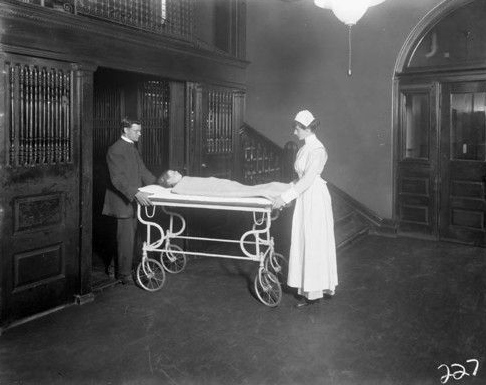
Below is the picture of a child who’s just been given a shot of insulin for the first time in 1922, and he’s starting to wake up from DKA. He was in a Canadian hospital with a ward for diabetic children. Just weeks before, his parents sat at his literal death bed.

library and archives

photo source: Library and Archives Canada

He’s a picture of 4 time Olympian, Kris Freeman. He happens to have Type 1. In the photo, he’s training for another race and is wearing an insulin pump, Omnipod, on his arm.

In both pictures, we can see the life that insulin makes possible, and what’s harder to discern, but still visible, are the implications of being diabetic versus having diabetes.

Being diabetic once meant limitations, and yes, having diabetes requires my son to make sacrifices and take extra steps, but being a person with diabetes puts the focus on personhood. Thankfully, we’re living in an age when having diabetes means it’s a conversation about what we can do instead of what we can’t, and that’s ultimately the difference between diabetes and diabetic.


Social Media for the Social Good

“Social Media for the Social Good,” that’s how Kerri Sparling described the project, Spare a Rose Save a Child, on Stacey Simm’s February 2nd podcast, Diabetes Connections. The idea behind Spare a Rose Save a Child is simple: buy one less rose than you would have on Valentine’s Day and donate its cost. By donating $5, the cost of one rose, a child is supplied with insulin for a month.

spare-a-rose-life-for-a-child-image

Living with a chronic condition means you have to secure your oxygen mask first, but when cabin pressure is restored, there’s an awe-filled moment when you can gaze out the window at the top of clouds and be amazed that you’re in about the fourth generation of humans who’ve lived on this earth, to fly in the air, and about the third to be alive since insulin’s been discovered. It doesn’t take long to recognize that access to life-sustaining medicine shouldn’t be relegated to where you were born.

As we were being discharged after our son’s diagnosis, a hospital pharmacist sheepishly walked into our room. He was carrying a large brown paper bag, and at first I thought it was odd that he was holding groceries. I thought maybe he was on his way home to prepare dinner and just wanted to check-in with the doctor, who was going over discharge orders with us. It turns out the sack held a month’s supply of syringes, lancets, ketone test strips, alcohol pads, and two kinds of insulin. As a way of apology, he said this was one of the worst parts of his job, entering the room of a young child who had just been diagnosed with a lifelong disease and letting the family know that they’d be billed around $500 for the month’s supply of medicine and medical equipment the hospital was sending home. He then noted that we had good insurance and would be paying less than that.

And we do have good insurance. In fact, we have access to everything (medical equipment, doctors, education, medicine) that we could possibly need to take care of our son’s diabetes, but this isn’t true for the underinsured, those without insurance, and those living in developing countries. Diabetes is hard, and we have everything we need. Diabetes is hard, and it’s unthinkable for those who don’t have what they need. This Valentine’s Day instead of buying chocolate and flowers, we’re buying insulin for someone. What’s sweeter than that?

Diabetic v. Diabetes

My son was diagnosed with type 1 diabetes when he was three, so it took some time for us to master a new lexicon that had suddenly become part of our daily language: ketones, glucagon, hypoglycemia, and the list goes on. For the first few weeks after diagnosis we moped around the house, afraid to leave for fear of restaurants and grocery stores, puzzled at how to check a blood sugar in the car with a kid in a carseat. During this time, Henry had lots of questions about his “dia-bee-bees.”

Even in those early days after diagnosis, when someone referred to my son as “a diabetic” it irked me in a way I didn’t fully yet understand. When I broke the news of Henry’s diagnosis to friends and family, I closed the email with, “Henry is a healthy three-year-old boy, who also happens to have diabetes.” In those early murky days, when I was struggling to understand the difference between Lantus and Humalog, it was always clear to me that Henry was a person before he was “a diabetic.”

The 2016 Standards of Medical Care in Diabetes is out, and there’s a huge shift in the lexicon surrounding diabetes. The Summary Revisions section declares, “In alignment with the American Diabetes Association’s (ADA’s) position that diabetes does not define people, the word ‘diabetic’ will no longer be used when referring to individuals with diabetes in the ‘Standards of Medical Care in Diabetes.’ The ADA will continue to use the term ‘diabetic’ as an adjective for complications related to diabetes (e.g., diabetic retinopathy)  (54.)'”

“Diabetic” is an adjective for complications related to diabetes, not my kid. My kid is a person with diabetes. Sure, “person with diabetes” (PWD) is more awkward to say; there’s three additional syllables, and the language is obviously stretching to avoid labels, but the change in perspective can be life-enlightening.

At our house, we used to call the Fed-Ex delivery van “the pincher truck.”

IMG_8536

a pincher truck on delivery

This made total sense to Henry, who came up with the name. One day after he’d spent the night in the hospital, his parents, who’d never physically hurt him, had to hold him down 5-7 times a day and give him shots. Not only did they have to give him the shot, but they had to hold the needle in and count to three just to ensure better delivery of the insulin. Sometimes, they had to do this in his sleep. Then they started taping these pinchers (Dexcom) to his skin, and these pinchers came out of the pincher truck every month or so.

Henry’s almost two years into living with diabetes. He wears a pump and CGM (continuous glucose monitor), and he understands why. He’s also learned that sometimes toys come out of the pincher truck. He’s learning there’s never just one thing in this world. There are people, and some of those people have diabetes.

The first line of the 2016 Standards of Medical Care in Diabetes Introduction reads, “Diabetes is a complex, chronic illness requiring continuous medical care with multifactorial risk-reduction strategies beyond glycemic control. Ongoing patient self-management education and support are critical to preventing acute complications and reducing the risk of long-term complications.” That’s some heavy shit.

Here’s the subtext of that Introduction. Diabetes is a disease and a condition. Diabetes (types 1 and 2) is presenting complexities to a medical system that’s been modeled on fixing acute conditions, not managing a chronic disease across a person’s lifetime, which is why so much of the care, education, and financial burden for diabetes falls on the person and the person’s family.

My son needs strength and confidence to take the extra steps of self-care to manage his disease. At five-years-old, he’s already making sacrifices that are necessary to live a healthy life with diabetes. Those first seeds of strength and confidence come from others seeing him as a person first, not a condition.

Diabetes & Anniversaries

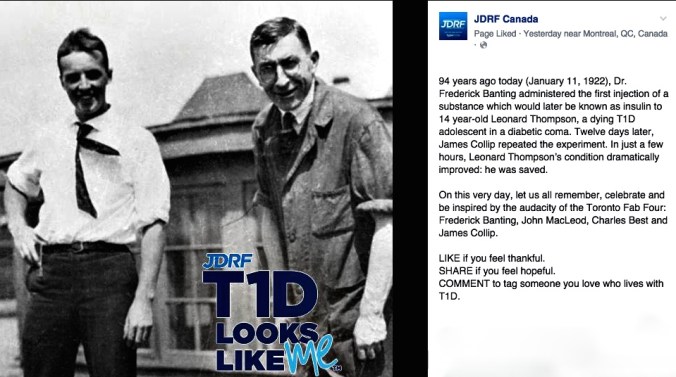
On January 11th, two seemingly unrelated images from the past crossed my Facebook newsfeed. The initial image, from JDRF Canada, celebrated the first injection of insulin given to a human 94 years ago on January 11, 1922. The patient was Leonard Thompson, a 14 year-old boy in a diabetic coma, what was then the end stage of type 1 diabetes. Within hours Thompson began to recover, and the discovery of insulin was immediately heralded as one of the greatest accomplishments of modern medicine. In fact, the The Nobel Prize in Physiology or Medicine was awarded to Banting and Macleod in 1923.

banting best

I’m fascinated with the medial history that surrounds T1D— both in the disease’s enigmatic nature as well as the scientists, doctors, and patients that seek to end T1D.

The second picture that crossed my newsfeed is from January 11, 2014. As a family, we were looking forward to seeing our first movie in the theatre and taking a walk downtown afterword. The songs and characters from Frozen swirled on the screen, and my daughter sat on the literal edge of her seat, holding my hand and inhaling with delight. Henry collapsed into his papa’s lap, and barely moved during the show. Since this was his first time in a theatre, I thought that maybe the light and sound were disorientating to him. I tried to make light of his grumpiness, so I took a picture of him.

movie fro

January 11th, watching Frozen;   diagnosed with T1D on March 6th

Now when I look at the picture, I see his flushed cheeks and puffy eyes, which happen when he’s had a persistent high blood sugar. The small Sprite in the cup-holder (probably the second or third soft drink he’d ever had), haunts me, and  I understand why he was lethargic during the movie and walk.

Around the time of the photo, the only symptoms he showed were irritability and lethargy. About three weeks later, my mother visited and commented on the heaviness of Henry’s morning diaper. I said, “I think he might have diabetes.”

When I said that, I didn’t really think Henry had diabetes, but I must have said it to voice an irrational fear, so the absurdity of the worry would become a talisman against its reality, like knocking on wood.

Parents of young children with type 1 diabetes often talk about the last picture of their child before diagnosis, noting the bittersweet moment. Usually, the photo shows some evidence of weight loss or lethargy, so parents beat themselves up for not knowing what was going on. On the other hand, there’s great liberty, because they didn’t know what they didn’t know— the ceaseless, worrisome nature of type 1 diabetes— a paradox  photo of a really sick kid in a last moment of joyful blindness.

When both these pictures crossed my newsfeed on January 11th, my first thought was thankfulness. How little time has actually passed between these two moments, but how many lives. Henry’s great grandfathers were born before the invention of insulin, and it’s only because of insulin that Henry’s alive.

In the early days after a T1D diagnosis, there’s shock and sadness, but there’s also an awareness of the great heritage of suffering and success that comes with T1D. I hope we’re at a moment in T1D history when the burden of care improves and the instance when some unlikely, scrappy doctors and scientists stumble onto the next breakthrough.


The CDC is Getting Diabetes Wrong

A recent article from diaTribe, “New Study Suggests Childhood Type 1 Diabetes and Kidney Disease are On the Rise,” should have T1D families and non T1D families alike on the look out. Basically, the article cites a research study published in Diabetes Care that uses data from insurance companies to draw the conclusion that in 11 years the instance of type of 1 diabetes has almost doubled in children.

Here’s the poignant quote from diaTribe’s article, “According to a new study in Diabetes Care, more US children and adolescents have been diagnosed with type 1 diabetes in recent years: the disease’s annual prevalence in a large, insured population increased 53% between 2002 and 2013, from 1.48 to 2.33 cases per 1,000 people. The study used data from insurance companies to survey the rate of diabetes in ~10 million US children and adolescents younger than 18 years old, so it does not tell us how diagnoses of type 1 may be changing in adults” (diaTribe). 

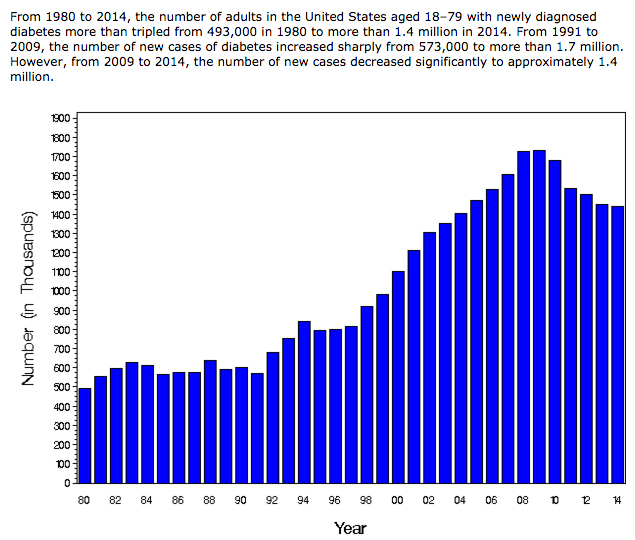
It’s alarming for any disease to double its rate of incidence in 11 years, but what’s truly alarming is that one of the US’s major operating components of the Department of Health and Human Services, the CDC, gets diabetes wrong. In a major 34 year longitudinal study released in 2014, the CDC makes no distinction between type 1 and type 2 diabetes. Type 1 diabetes is an autoimmune disease, caused by the body attacking its own beta cells and stopping insulin production. Type 2 diabetes is when the body overproduces insulin, but insulin cannot enter the body’s cells, and this process is likely a product of lifestyle and genetics.

Since the CDC makes no distinction between type 1 and type 2 (again two separate and different diseases), it’s able to make the claim that diabetes is on the decline because 2009 saw a trending decrease in the incidence of type 2 diabetes. Here’s a link to the CDC’s study.

CDC 2014 diabetes graph

graph from CDC’s study, “Annual Number (in Thousands) of New Cases of Diagnosed Diabetes Among Adults Aged 18-79 Years, United States, 1980-2014 source: CDC

This study has angered families affected by type 1 because the CDC illustrates a willful lack of understanding in two separate diseases. Additionally, and this is the point I find most frustrating, the CDC has no disease registry of type 1 diabetes.

Remember the reporting of the Ebola crisis that started in March 2014? The number of cases in specific countries was reported daily on multiple news outlets because Ebola was a reportable disease that had a disease registry. Here’s the CDC’s (in partnership with the World Health Organization) current cases. As of this writing, the cases were updated on January 6, 2016, yesterday.

I’m not comparing Ebola and type 1 diabetes; however, if the CDC has the ability to track a disease in distant third world countries and provide up to date current information to the public, certainly the CDC should be able to track the cases of type 1 diabetes within its own country.

Why are insurance companies the ones tracking type 1 diabetes in childhood? Is there a clear picture about type 1 diabetes in the uninsured population? If the CDC were tracking type 1 diabetes AND separating it from type 2, what would the graph for type 1 look like? Between 2002 and 2013 the blue lines would almost double in height. That’s certainly an increasing epidemic worth tracking, especially if type 1 diabetes has an environmental trigger.

Type 1 diabetes was once a rare childhood disease, but it’s increasingly less rare. With the incidence of type 1 diabetes increasing across the globe, but without numbers to study, a cause and cure will remain elusive.

The type 1 community is reacting and calling for change. Here are some actions you can take.

Living with type 1 diabetes presents enough hardships and frustrations, so the government organization whose mission includes,”increas[ing] the health security of our nation” should not be another frustration.

Richard’s Diagnosis Story

Diagnosis stories are powerful teaching tools that help people learn to recognize the symptoms of type 1 diabetes. For the person diagnosed with type 1 diabetes, a diagnosis is the day his or her life changes and goes forward. Semisweet is sharing “Richard’s Diagnosis Story” in his own words. Richard has been living with type 1 diabetes for over 70 years. In 2006 he joined the diabetes online community, where people were fascinated to hear Richard’s story of living with T1D in the 1940s and beyond. In 2010, Richard published his autobiography, “Beating The Odds: 64 Years Of Diabetes Health.”

Richard, diagnosed at age 6, September 1945

I was born in 1939, in Roanoke, VA, and I had several illnesses before my fifth birthday: three different kinds of measles and my tonsils removed. When I was five I had chicken pox and mumps, and while recovering I began showing the classic symptoms of diabetes— excessive peeing and drinking so much water. My parents took me to three different doctors, but they did not recognize my symptoms, so there was no diagnosis. I lost my appetite, and refused to eat. I just wanted to drink.

One doctor prescribed a tonic that was supposed to restore my appetite. I still remember the bad taste and tall glass bottle filled with dark brown liquid. It was like the snake oil medicine that we have read about from the past. The tonic did not help at all. It probably made my condition worse because it contained sugar. By the time we saw a fourth doctor I was very weak, and had lost a lot of weight. My ribs were very noticeable when my shirt was removed. The fourth doctor recognized my symptoms, and took a blood sample in his office. The sample was sent to a lab, and we waited a few days before returning to his office for the results.

His office was on the second floor of a building on Main Street in Salem, VA, and I struggled to slowly walk up the long flight of stairs. My father was carrying my three year old sister, but I was too big to be carried. In the doctor’s office, my mother and I sat in chairs while my father stood behind us, still holding my sister. I do not remember the doctor’s face, or his words, but I’ve never forgotten my mother’s pale and frightened face. In September 1945, a few days after my sixth birthday, we were told that I had sugar diabetes. I was hospitalized the next day, and don’t remember much about the stay, except for the injections and the blood that was collected. Insulin, taken from pigs or cows caused me to gradually regain my appetite, and I stopped losing weight. By the time I was home, I looked like a human being again, and my strength was very much improved.

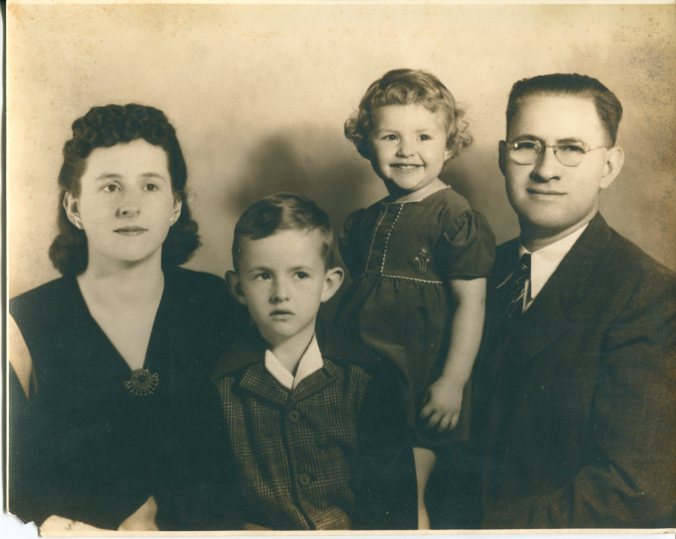
10258864_1238484469500822_1295893666899560174_o

Richard and his family a few months after his diagnosis

While in the hospital, I was treated by Dr. Davis and he became the doctor for my whole family. I saw him every six months, and he took blood samples, testing them in his office lab while I waited. My blood sugar was always high, but I don’t recall him ever mentioning numbers. We were not concerned though because we did not know about the complications that might occur with my eyes, kidneys, and other body parts. One shot per day, one urine test, large portions of food, and no worries. Ignorance was bliss.

There were no meters for testing blood sugar at home until the 1980s, almost forty years after my diagnosis. We tested my urine at home, every morning, but the procedure for doing that was very awkward. The first thing I did each morning was to pee in a cup. Some Benedict’s solution was placed in a large test tube, and several drops of urine were added. The test tube was placed upright in a container of water on our stove. When the water had boiled a while, the test tube was removed, and the color of the solution was observed. The original color of the Benedict’s solution was blue. If the solution containing the urine was blue, after boiling, then there was no sugar present in the urine. If sugar was present in my urine, then there would be colors: green, yellow, orange, brick red, or brown. Green showed a low amount of sugar, brown showed very high sugar.

944912_1236570436358892_5889406186695641956_n

testing blood sugar with Benedict’s solution

It was nice that there was only one injection each day before breakfast, but there were no fast and slow acting insulins, so control of my blood sugar levels was not good at all. The animal insulin was a 24 hour insulin, so the morning urine test result determined the dosage, but urine tests do not approximate blood sugar well. The glass syringe and metal needles were kept in alcohol, and sterilized with boiling water on the stove once each week. We had our own well, and the water contained limestone deposits. After boiling, there was a white film on the needles and syringe, so we had to use a whetstone to remove the deposits. The limestone frequently clogged the insides of the needles, so we had to push a small wire through the needles to unclog them. If the deposit was not removed it was difficult to push the needle into my skin. The needles were almost three quarters of an inch in length. I was supposed to push the needle into the muscle on top of my legs, or on my arms. My father gave me my injections until I was ten.

During the night I would sometimes have hypos. Some of those hypos became seizures. I would thrash around during my sleep, my teeth clinched, my muscles would become drawn, and I was almost unconscious. Mother poured small amounts of the sugar water they kept nearby on my lips, until I had enough in my mouth to partially awaken me. Then I drank the liquid more freely. I was always drenched with sweat, and very weak after a seizure. My body was sore the next day and the sugar water caused my urine test to show high the next morning. I continued to have seizures for many years, but they occurred less frequently when I was older. There was never any effort made to call an ambulance. Perhaps it was because the nearest hospital was at least 10-15 miles from our house, and I doubt that the paramedics in the ambulance had glucagon injections. Home care was probably the best solution. I think my mother saved my life many times during the years I lived at home.

Dr. Davis told us that I should not eat sugar, but no other instructions about an appropriate diet were given, so we didn’t know about carbohydrates. We lived on our little ten acre farm, and we had cows, chickens, pigs, and a horse. There was a very big garden, and an orchard. We bought very little food at the grocery store, so processed food was rarely part of my diet. Our own milk, eggs, vegetables, and fruit were readily available. We had meat from the chickens and pigs. Mother canned food each summer and fall. I helped my father with the farm work, and I was very hungry, so I ate big portions at every meal. I ate all the same food that my parents and sister ate, except items containing sugar. Mother used saccharin to sweeten the pies, cookies and cakes that she made for me. I ate lots of bread, potatoes, and other things that were not good for me, but we thought all foods were okay, if they did not contain sugar.

My parents did the best they could for me during my childhood and Dr. Davis gave no instructions that helped. We did not know there could be potential problems, and I led a rather normal day to day existence. There were no health problems with my diabetes throughout my childhood, despite my very irregular blood sugars. I have often wondered why I did not have DKA back then. Was something protecting me? All the fast acting carbs I ate each day (without correction boluses like I take now) must have kept my blood sugar very high. I’m sure my parents were devastated by my diabetes, and not knowing how to care for me. My parents raised me in much the same way that they were raised in their mountain homes. They were raised on farms, and they loved that kind of living.

When I talk to parents of T1D children diagnosed today, I advise them to join online diabetes support groups for parents. Children with Diabetes, created by Jeffrey Hitchcock, and the many parents’ support groups on Facebook are very good sources of advice and information for parents. Getting support from experienced parents can help so much! There are books that are available, but I think the online community is best. Having T1D children meet other children in their communities is a very good idea. Diabetes camps in the summertime are an excellent idea. Attending the Friends For Life conference in Orlando, FL is another source that I have seen work so well with children who are type 1.

10903837_1036689413013663_7375763260254691701_o

Richard at 76, having lived with T1D for 70 years

If you’d like learn more about Richard’s life with type 1 diabetes, then check out this video interview where Richard shares his experiences with Daniele Hargenrader. Richard was also interviewed about living with T1D for over 7 decades on Diabetes Mine. Richard will also be a speaker at the 2016 FFL conference in Orlando, FL. You can follow Richard on Twitter @Richardvau157.

Charitable Fighting

On episode 41 of the Juicebox Podcast, host, Scott Benner talks with the JDRF’s Director of Discovery Research, Albert Hwa, about some of the current and promising research the JDRF is doing. During the interview Benner posses an almost rhetorical question, “What’s the last thing we cured as a society? Is it polio?”

This question hit me hard, maybe because I was pulling into the drugstore parking lot to get yet another month’s supply of insulin and test strips. We’ve never told our son that his diabetes will be cured. I don’t count on type 1 diabetes being cured in my lifetime, or his. I hope it will, and it’s wonderful to hope and support the goal of curing diabetes, but I think it’s dangerous to promise a young child with diabetes that his or her disease will be cured.

If Henry grows up believing that his disease will be cured in five or twenty years and it isn’t, how will this affect his feelings toward the organizations, scientists, and doctors who are working on a cure? I’ve heard so many people and families affected by T1D talk about turning away from charities, organizations, and even their own self-care, because at diagnosis, medical professionals and organizations said a cure was on the horizon in X years. And after X years arrived, there’s no cure.

When Henry asks if he will have his diabetes forever, we tell him yes. In general, when “yes” is a harder answer than “no,” the question is serious. We tell Henry that he’ll have his diabetes forever, but that it will get easier to have T1D because doctors and scientists are working really hard on ways to make diabetes hurt less and be easier to take care of.

If you follow diabetes research, you’re well aware that people have strong opinions about the JDRF, The Faustman Lab, and other organizations. The stakes are high and charitable giving is limited, so it’s natural that opinions butt heads. Shorty after our son’s diagnosis, I was on the phone with our local chapter of the JDRF. I’ve read about the promising trials going on at the Faustman Lab, and I was in the room when Ed Damiano released the iLet this summer. Some people gasped, and others who’d been living with diabetes for decades began to cry, and in my own anticipation for Henry to have a better life, it struck me that this is one of the many ways hope arrives.

20150709-CK-CWD2015-3581

Photo Credit: Jeff  Hitchcock, Friends for Life

When Banting first conceived of insulin, it’s rumored he was in a semi-intoxicated state, preparing for a lecture on metabolism in the wee hours of the morning, while in a less than prestigious lecturer position. He was largely working in isolation without much support. Lightening may strike twice, but I’m not counting on the next diabetes breakthrough to emerge from isolation and without support.

I don’t know if the next advancement in diabetes care will be islet transfers, beta cell encapsulation, or related to immunotherapy. I do know that it’s important that my son sees us supporting the people who work everyday to make his life easier.


This week, Semisweet donated money to the Bionic Pancreas, the Faustman Lab, and started Team Henry for our local JDRF One Walk. We added a Donate page to provide more information about diabetes research. Please consider joining us in one of the causes.