When Type 1 Knocks on Preschool’s Door

Parents of young kids with T1D know that sweaty palm, nervous gut feeling of leaving their child with someone new, especially someone new to diabetes. Handing over the diabetes equipment means handing over trust of your child’s consciousness, and over time, his or her long term health. It’s never easy to do this, but for two years, we worked with two amazing preschool teachers who share their experiences of learning about Type 1 and managing it in a preschool classroom. “When Type 1 Knocks on Preschool’s Door” is by Jessie Blohm.


It has been two years since diabetes knocked on the classroom door. Two years ago we were, admittedly, afraid and unknowledgeable. Two years ago, I could have told you the difference between Type 1 and Type 2 only by way of saying that Type 2 was the kind that elderly people can develop and a result of the obesity epidemic. Other than that, I had no idea what the difference was or how much we would learn in two short years.

Insulin, units, blood glucose (BG), meter, lancet, pump, bolus, combo bolus, pre-bolus, etc…the language alone was enough to make my head spin. How were we going to learn all of this in one week, so that we could keep Henry safe at school? It didn’t matter how, it just mattered that we would. A couple evenings of reading The First Book for Understanding Diabetes and a crash course in testing with the meter and we were on our way. Well, not quite that easily, but it did happen that quickly.

I believe that there were 4 key factors that made Henry’s time in our classroom so successful and relatively stress free for his parents.

#1. Caring and attentive parents

Henry’s parents were willing to meet with teachers before the start of school with step by step handouts, powerpoint, scales, cheat sheets— anything and everything they could think of to inform two lead teachers and a handful of college students on how to best care for their son. Rachel and Matt were able to answer questions when we had them, walk us through as new situations like priming the pump or delivering a combo bolus arose. They stressed the importance of realizing that there was no “normal” situation when “managing” diabetes and that so many factors play in to Henry’s numbers on any given day. They gave us a list of our typical snack foods as well as the portion sizes and carb counts, taught us how to weigh foods for lunch, and count carbs in each serving size. We used those cheat sheets religiously and by the end, we were able to take a cooking activity for the classroom, modify the ingredients slightly, and figure out how many carbs were in it so that we could give Henry the correct amount of insulin and most importantly, that he was able to participate in the same activity that the rest of the children were.

#2. Lots of checking…and double checking, and sometimes even triple checking

Before going outside for large motor, “Henry, let’s check you.” While at group, “Anna, will you check the CGM?” While getting ready for lunchtime, “Lexie, will you text Rachel and Matt to check if that amount of insulin sounds correct, it seems high.” Preparing for a center time cooking activity, “Double check my math on this portion size for the cooking activity, do you get the same numbers that I do?” The CGM needs calibrated, “Two different checks (pokes) this time, Henry.” In the beginning, this was a complete tag team effort between us as co-teachers, standing shoulder to shoulder at the counter as we figured the carbs for his lunch/snack/activity. After two years, it was like a well choreographed dance, we were able to have a quick conversation about his numbers that day, make a guess on how lunch/snack/activity would effect his blood glucose, and move between the different roles as lead teacher/lead caregiver with ease….but it took a lot of “checks” to get us there.

#3. Trust

It had to have taken an amazing amount of trust on Henry’s parents behalf to hand over his backpack each day and trust that we were going to stay on top of his numbers, catching any highs or lows from a new breakfast food, our lunch menu, and his activity level. Trust in our student staff and their training when we were out of the room or in a meeting. Trust in the CGM in order to avoid an unnecessary finger poke. Trust in the Dexcom app and knowing that there were 4 sets of eyes randomly checking his numbers throughout the day and sending a precautionary text to whomever was with Henry (teacher/staff), just in case they hadn’t caught it.

#4. Acceptance

In our classroom, we call everyone “friends” and we work hard to promote acceptance, resilience, and kindness. After diabetes knocked on the classroom door, we had a new topic to cover. Sugar. Much like we begin every school year creating that classroom community, we hit all of our usual likes/dislikes, how we all are the same and how we are different, etc. It was decided that we all liked sweet treats and we all understood that too many sweet treats would give us a tummy ache. However, for Henry, his body needed help with the sugar and he had to wear the pump so that it would keep giving him medicine in order to be safe. The children were so accepting of this! They would occasionally take an interest in watching us check Henry’s BG, ask an occasional question, or tell us they heard a beep from the pump, but more often than not, they didn’t even notice anything different! Henry was resilient, could go wash his hands, check his BG quickly, and return to his play with little interference, it was just accepted as part of the classroom routine and community. In all honesty, acceptance, resilience, and kindness are probably the best qualities in young children, and the rest of the class made it easy. I only hope and pray that the rest of Henry’s years of school are equally as accepting and kind to him.

DSC00906

Jessie and Henry

Jessie Blohm is a teacher and a mother, holding her Masters Degree in Early Childhood Education from the University of Northern Iowa, while earning her Mother of 3 degree at home in her partially remodeled farmhouse in Reinbeck, IA. She lets her kids run barefoot and would rather pick weeds in the garden and drive kids to soccer practice than cook any day.

Sugar Surfing Into Summer

We live in a small Midwestern town, where it’s a winter’s winter about five months out of the year. In deep winter, the temperature (not the windchill, the actual temperature) can reach -24 Fahrenheit. In mid-March, just when the snow, salt, and ice threaten to become a forever feature, there’s a little less gray and the icicles drip away. In the next month, the snow melts, tulips emerge, and the town’s most popular ice cream joint opens for the season. There’s always a line of people and taillights, celebrating a baseball game or summer evening.

Having type 1 diabetes does not prohibit what people can eat. People with T1D can eat anything; however, many people choose to limit or eliminate certain foods simply because it makes blood sugars potentially easier to manage. Right now, we don’t eliminate food, but eat a little bit everything in moderation. When we get an ice cream, it’s a celebration.

Recently, we’ve discovered the power of pre-bolusing and are starting to practice some of Dr. Ponder’s Sugar Surfing advice. It can be nerve-racking to pre-bolus a large amount of insulin for a restaurant meal or special treat, particularly when there’s little control over when the carbs will arrive. Matt is a lot better about waiting out the downward slide than me. I nervously check and recheck the CGM.

IMG_9501 (1)

on our way back from the local ice cream joint

But then the sugar starts to kick in— the rise is more gradual and less extreme. The insulin action time better matches the carbs. We’ve figured out if we give enough insulin to cover for 30 carbs that by the time we’re through the line, with a strawberry ice cream baby cone in hand, that his blood sugar usually evens out to about 145 half an hour later. I’ll take a rolling line after ice cream any summer night.

IMG_9522

Hello, summer. 

“I Can Spell to 100”

I didn’t have time to be nostalgic about my youngest kid participating in Kindergarten Round Up, (a preview of elementary school for preschoolers entering Kindergarten next fall). Instead, there was a flurry of emails to the school administration, nurse, and staff. There were meetings, apps were downloaded, and then the morning of Kindergarten Round Up rolled around.

IMG_9578

It’s hard to bolus for emotions.

Just a quick glance at Henry’s face shows how excited he was, and a quick look at his blood glucose on his Dexcom CGM (continuos glucose monitor) shows how anxious he was to attend the same school as his big sister.

Adrenaline is a hormone that’s secreted during stress, and it raises the blood sugar. We’re learning that many things raise or lower blood glucose: a growth spurt, illness, puberty, exercise, emotions, a unicorn jumping over a blue moon after a black cat crosses its path, and just because.

Days before we walked through the school doors, I knew it would be another vacillating moment of living with diabetes: a challenge to preserve the typical experience, while ensuring safety and health. And it was. Henry’s first introduction to school was meeting with administration and the nurse, listening to us talk about his blood sugar. But he’s heard us talk about his blood sugar so much that it’s old news, no news. But Kindergarten, that’s new news. He was bouncing, happily telling everyone, “I can spell to 100.”

And he can spell (and count) to 100. If a blood glucose of 300 is any indication, this kid is excited to go to Kindergarten.

Preschool Graduation: All the Feels

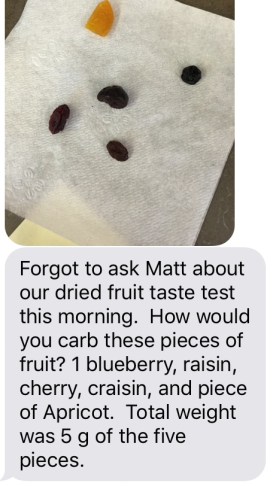
The preschool our son attends is wonderful. His primary teachers have Dexcom Share on their phones, and we usually text several times a day about carbs or insulin dosing. Here’s a text we got a few days ago.

IMG_9467

Yes, his teacher picked out a dried blueberry, raisin, cherry, craisin, and part of an apricot, weighed them, took a picture, sent a text, waited for an answer, and delivered insulin to our kid. In a preschool classroom. This is to say nothing of the Bakery Unit they had last month, which was also handled with care and attention.

This morning, Henry graduated from preschool. I have all the normal parent feelings of time passing too quickly, pride, and fear as my child grows bigger into a much bigger world. But, I also have caregiver-parent feelings, which are messier, more full of fear and dread. I try not to let those caregiver-parent feelings invade these happy milestone moments, like leaving preschool and starting kindergarten. However, milestone moments are inherently reflective. So, the thoughts of my son’s short, but complicated history, coupled with a future inextricably linked to a chronic disease, sometimes share space with joy. If I’m not saying this clearly, Pixar did: think of Sadness and Joy from Inside Out.

He’s five and has lived a life of more medical intervention than me, and most other people my age. His medical history (not all related to diabetes) is a long list of specialists: pediatric neurologist, neonatologist, ENT, immunologist, pediatric endocrinologist, infectious disease specialist, E.R. physicians, multiple anesthesiologists, and several primary care physicians. I stood beside his isolette in the NICU for weeks after his birth and climbed into five separate hospital beds with him over the past five years, and I know I’ll need to be prepared to climb in again. 

I’ve seen my son, and he’s seen me, in really scary basins and valleys, so we’ve learned the value of looking at something else: a tenacious mountain goat climbing a rock face, a cool cat handing a diploma to a kid who is going to rock kindergarten.

IMG_9476

Henry with his preschool teachers, a preschool diploma, and TC!

I Wish People Knew That Diabetes…

Kelly Kunik, who blogs at Diabetesaliciousness, created the hashtag  #IWishPeopleKnewThatDiabetes, and the idea is that on April 20th of every year people share what they’d like others to know about living with diabetes so that no one feels alone on the T1D journey and that others are educated about a life with type 1.

It’s very similar to the project #IWishMyTeacherKnew, and last year over 17 millionTwitter impressions were created with #IWishPeopleKnewThatDiabetes. Sharing fears, hopes, and struggles as they relate to a life with type 1 is certainly raw, but also cathartic. It’s been two years since type one entered our home, and the longer it’s around, I realize that T1D will touch almost every aspect of our lives, but the real challenge is to learn that it will touch every aspect of our lives, and to move on despite it.

When our son was diagnosed with type 1 diabetes I knew that we didn’t do anything to cause it, that he would need to use insulin for the rest of his life, and lows and highs were dangerous. Now, I know more about diabetes, and in the spirit of advocacy, I’m sharing, in no particular order, ten things I wish people knew that diabetes…

  1. I wish people knew that diabetes makes me sad/upset/frustrated/exasperated when I’m at the grocery store.
  2.  I wish people knew that diabetes is often why I’m looking at my phone. I’m checking my son’s blood sugar remotely so that I can check back in on the task at hand.
  3. I wish people knew that diabetes occupies about an hour and half of my time per day, about $200 a month, and we’re lucky to have time and good insurance.
  4. I wish people knew that diabetes means I fear that one day my son will attempt to take his own life by purposefully administering too much insluin.
  5. I wish people knew that diabetes makes me monitor my other child’s water intake, weight, bathroom habits, and moods because I’m afraid that she too will develop type one diabetes.
  6. I wish people knew that diabetes forces me to sometimes trust people I don’t know very well with my son’s literal life, then after he learns to care for his own diabetes, I will have to trust a teenager to make mostly good and responsible life and death decisions multiple times a day, more or less consistently.
  7. I wish people knew that diabetes makes me afraid I might outlive my son.
  8. I wish people knew that diabetes is why I haven’t had a good night’s sleep in more than two years.
  9. I wish people knew that diabetes means almost every week I read about someone who died because they had the same disease as my son.
  10. I wish people knew that diabetes means I have to choose to believe that living with a chronic disease makes people stronger and not weaker, because that’s the way forward.

Please consider sharing your thoughts using the hashtag  #IWishPeopleKnewThatDiabetes on social media on April 20th.

Sleep, Snow, & April

Earlier this week, Beyond Type 1 posted an article, “I Can’t Sleep,” by Sara Jensen. In the article, Jensen describes the lack of sleep, stress, and ceaseless work that create Caregiver Anxiety. I’ve had every experience that Jensen describes, from a doctor admonishing me that my health is being negatively impacted due to stress to worrying that if I sleep through an alarm my child could die.

She writes, “I lay back down and I breathe in, I breathe out, my mind tells me I won’t be able to fall back asleep, and when I do, the alarm goes off again. It feels like I never closed my eyes at all,” which perfectly describes the mixture of sleepless exhaustion and stress parents of kids with T1D often experience.

At our house, some nights blur by in a flurry of insulin, alarms, juiceboxes, and more alarms.

Recently, I traveled for work, and during that week, Henry was being cared for by his father, and my mom, a nurse. This wasn’t my first time away from him after diagnosis, nor was I afraid. I knew he was in good hands. Yet, 1,806 miles away I woke about every two hours, suddenly, as though a giant animal had jumped on my chest, forcing out all my breath. But instead of an alarm or lights blaring, there was just the night. It was quiet. I looked at Henry’s BG on my phone, it was usually in range, and I’d go back to sleep.

After about the fourth night of waking up in a state of emergency when there was no emergency, I realized how profoundly T1D care impacts the most basic aspects of life: sleep, not sleep, food, and how I think about my son. But profoundly realizing something doesn’t change it. I woke up the same way the fifth, sixth, and seventh nights because I’d been waking up this way for two years– the same animal feeling, but I wasn’t afforded quiet to think about it– there was an obligation or almost emergency to contend with, asleep down the hall, in need of insulin or juice.

When Henry was diagnosed with T1D, what I didn’t know about type 1 could fill the stratosphere. For example, I didn’t know that I wouldn’t be able to sleep through the night for the next two years. Now I wonder if I ever will sleep through the night.

Before I left for work this morning it was blustery, while a few wild snowflakes dashed down. I checked my phone before the workday began, and I laughed when this image from FB popped up from three years ago.

IMG_9334

I laughed because when I looked up from the screen, through the kitchen window I watched it snow on daffodils, but there was a time that I didn’t know what I didn’t know. Three years ago not a snowflake was in sight: eleven more months to live without T1D, to sleep through the night, to eat food without weighing it, without weighing so many vital daily decisions that have become necessarily mundane.

The thing about winter in the midwest is that snow turns to mud, turns to flower. It’s just a waiting game, like waiting for a blood sugar to rise or fall.


A New Haircut

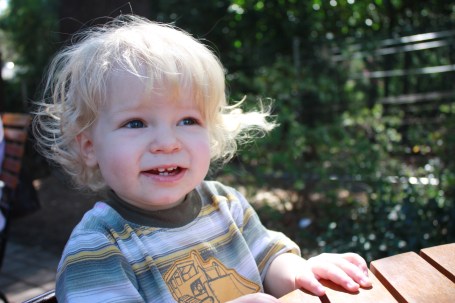
I was that mom who waited way too long to cut her son’s curly locks. In fact, this photo, taken when Henry was 18 months old, was what shamed me into getting his fist haircut.

IMG_8311

Henry, in need of his first haircut, two years and two days before his T1D diagnosis.

You see it right? That not-so-cute blonde Bozo the Clown hairstyle.

So we got his hair cut. No big drama. He ate a sucker while the stylist cut his hair. She put a few curls in an envelope for me to keep. About every eight weeks we’d repeat the same steps: sucker, haircut, not much drama. Then Henry was diagnosed with type 1 diabetes.

Immediately after his T1D diagnosis it dawned on me that some things, like eating in a restaurant, are possible, but more difficult. But other times, suddenly, we’d be in a situation where I didn’t think T1D would be an issue (like getting a haircut), and it was.

At Henry’s first haircut after diagnosis, he wanted a sucker before climbing in the chair. I scrambled for a piece of sugar-free gum to give Henry while gesturing to the stylist not to give Henry a sucker. But Henry was insistent, he wanted a sucker. I said not now, maybe later. The stylist told me that the sucker was just “a little one” and he could “pick his flavor.” I told her Henry has type 1 diabetes and he probably shouldn’t have a sucker right now, but we’d take it for later.

The short of it is that Henry left with two balloons, several stickers, and a rapidly rising blood sugar well over 200. I left with a lot of guilt. This would be the first of many times I’d have to refuse or accept a sweet treat offered at the bank or post office. There’s no easy way to casually disclose to a well-meaning stranger that your child has a chronic condition, so the sugar treat is not a good idea in the moment. And then there’s the kid, the one with the chronic condition, listening to everything that’s said.

Now, I run those errands before I pick Henry up at preschool so I don’t have to explain anything to anyone.

These days, I let Henry’s hair get a little longer than it should (but not Bozo style) before we get it cut. Last week, I took Henry for a haircut. After the haircut, the stylist asked Henry if he’d like a sucker. I didn’t say anything. He picked out a mystery flavor for himself, and then asked if he could pick one for his sister.

As we were walking out, he handed me both suckers and said, “Give this blue one to Ava, and save mine for me when I’m low.”

Crossing a parking lot with my five-year-old, who’d just given up his treat for a future medical emergency, I felt pride and a familiar sadness. All the sudden, I realized not only will T1D always be with him, but it is shaping who he is.

2nd Diaversary: 731 Days of Living with T1D

I like my birthday less than I used to. Of course it still happily marks another year of life to celebrate with friends and family, but March 5th also marks the last day my son would ever not have type 1 diabetes. On March 6, 2016, my son has been living with (diagnosed) T1D for 731 days (there’s a leap year in there), roughly 37% of his life.

IMG_8555

Semisweet Soap (0 carbs)

We haven’t figured out how to mark or celebrate his diaversary, a neologism for the anniversary of a diabetes diagnosis. I think we’ll wait for Henry to take the lead on this. However, I’ve been reflecting on this upcoming date for a few weeks now. Moments like this are mile-markers because they disrupt the routine of counting carbs, insulin delivery, and correcting highs and lows. If I think about the preponderance of diabetes care all at once, it’s overwhelming, so the task-to-task perspective allows me to get up each day, put my boots on, and do it all again. Yet, around these mile-marker moments, I usually peek out the window at the vast appalling and inspiring mountain range that is T1D management.

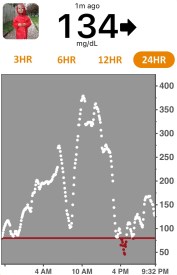
On March 1st, I recorded all my actions related to T1D care. Here’s one day of T1D care. It’s only one day. Some days are better. Some days are worse. We’ll do it all again tomorrow.


KEY

basal= background insulin being delivered by pump

bolus= a larger amount of insluin delivered at meal and snack to cover carbs

BG= blood glucose

CGM= continuous glucose monitor, provides an estimate of Henry’s blood glucose every 5 minutes

Dexcom Share allows us to see blood glucose values on our phones

ezBG= pump function calculates how much insulin to deliver to correct a high BG

IOB= insulin on board, the amount of insulin that has been administered and is still circulating


12:03 a.m.- check BG by blood, 74 with an arrow down to the side, half a juice box

2:00 a.m. – wake up to alarm, check BG on CGM, 147 with an arrow straight across go back to sleep

5:00 a.m.- wake up to alarm, check BG on CGM, 220 with an arrow straight across, so check BG by blood, it’s really 309, give 1.25 units of insulin, go back to sleep

7:00 a.m.- wake up to alarm, check BG on CGM, 137 with an arrow down to the side, so I get ready for work

7:30 a.m.- check BG by blood, 130, while Henry is still asleep, prebolus 1.5 units of insulin for a breakfast of 25 carbs

7:35 a.m.- help Henry get dressed so that the pump and CGM sites stay secure

7:55 a.m.- Henry eats breakfast, a low carb, sugar free muffin and a scrambled egg with cheese

8:35 a.m.- check BG on CGM 107 down to the side, get d-bag ready for school

9:05 a.m.- drop Henry off at preschool, get CGM on Wi-Fi, check BG by blood, 210, give .15 units of insulin to correct high

9:15 a.m.- listen to a diabetes podcast during morning email and class preparation

10:08 a.m.- text from Henry’s preschool teacher/s: Did another ezBG, I look at BG remotely, 320

10:59 a.m.- right before teaching, look at BG remotely, still 320

11:17 a.m.-text from Henry’s preschool teacher/s: We did another ezBG at 10:30 and it gave another .3. He had 1.07 IOB at the time. 

11:45 a.m.- Husband calls during class, saying he went to check on Henry, who has large ketones. Pump said to give 6.6, but this would be way beyond the most insulin Henry’s ever had at once, and it made my husband nervous, so he gave Henry 5.6 units of insulin to correct for large ketones and cover his lunch of grilled cheese and tomato soup. 5.6 is the second highest amount of insulin Henry’s ever had on board.

12:01 p.m.-look at BG remotely, 329 with an arrow up at the side

12:15 p.m.- listen to voicemail from drugstore about prescription problem with test strips

12:45 p.m.- while on a way to a meeting, read text from husband: I called the school and told them to go ahead and give the additional unit I was worried about, look at BG remotely, 363 with an arrow up at the side

1:15 p.m.- during meeting, unsuccessfully try not to think of Henry’s ketones and blood sugar

1:53 p.m.- text from Henry’s preschool teacher/s: We gave another unit and are continuing to push water. Will have cheese stick and beef stick for snack, husband texts back and asks that Henry be given 1 additional unit of insulin to help clear ketones.

2:30 p.m.- look at BG remotely, 263 with an arrow straight across

2:33 p.m.- look at BG remotely, 260 with an arrow straight across

2:38 p.m.- look at BG remotely, 260 with an arrow straight across, realize I have to stop obsessing and get some work done

3:08 p.m.- look at BG remotely, 141 with double arrows down, which means Henry’s BG is falling faster than 3mg/dL per minute, text to his teacher/s: Now he’s falling fast! What’s his real BG and how much IOB? 

3:16 p.m.- look at BG remotely, 111 with double arrows down, call classroom and talk with student worker who tells me that IOB is 1.16, I tell her to give Henry 2 glucose tabs, text husband this information

3:25 p.m.-look at BG remotely, 95 with double arrows down, I tell myself I am a logical person, that the sugar will do its job and the CGM is lagging, so he’s probably leveling off, not spiraling down

3:29 p.m.- text from Henry’s preschool teacher/s: 97 and .92 IOB, gave two tabs 15 min. ago, CGM says 84 with double arrows down

3:58 p.m.- look at BG remotely, NO DATA

4:16 p.m.- my phone buzzes with a Dexcom alert, I check, says he’s 64 with an arrow straight across

4:31 p.m.- my phone buzzes with a Dexcom alert, I check, says he’s 64 with an arrow straight across, then Henry walks through the door with his papa, who said his BG by blood was 112

4:46 p.m-. my phone buzzes with a Dexcom alert, I don’t check, knowing it’s still catching up form the fast drop

5:40 p.m.- check BG by blood, 95 and prebolus 1.4 units of insulin for a dinner of 40 carbs

6:10 p.m.- during dinner my phone buzzes with a Dexcom alert, CGM says BG is 74 straight across

7:00 p.m.- check BG on CGM, 121, an arrow straight across

7:28 p.m. – help Henry change out of his clothes and into his pajamas to preserve pump and CGM sites

7:32 p.m.- check BG by blood, 111, give .55 units for a high protein bedtime snack of 11 carbs

7:40 p.m.- add some new basal times and programs to avoid nighttime highs, which have been more or less constant for the past few days

7:56 p.m.- check BG on CGM, 160, an arrow straight up

8:56 p.m.- check BG on CGM, 157, an arrow straight across

9:32 p.m.- check BG on CGM, 134, an arrow straight across

9:46 p.m.- silence reminder alarm from pump to check BG 2 hours after insulin delivery

10:10 p.m.- check BG on CGM, 181, an arrow straight across

10:39 p.m.- check BG on CGM, 177, an arrow straight across, decide to check BG by blood, 209, give .7 units of insulin

11:32 p.m.- check BG on CGM, 168, an arrow straight across

11:42 p.m.- check BG on CGM, 158, an arrow straight across, set alarm for 12:40 a.m., 3:00 a.m., and 6:00 a.m.

FullSizeRender (5)

today 


#Teampancreas

T1D is a family disease. Our family has learned how to recognize and treat a low blood sugar. We make decisions about what to eat and when. We monitor blood sugars 24 hours a day. Henry’s sister also helps. She watches his numbers while they play and distracts Henry during site changes.

Part of Henry’s pancreas may not be functioning, but he’s got a village of support replicating (as close as humanly possible) what his beta cells once did.

Beyond Type 1 is celebrating #Who Do You Love? on their Instagram wall. Of course, Ava is a great addition to #teampancreas.When it comes to diabetes, there’s not a lot to celebrate; however, the way family and friends rally with support and understanding is something to honor.

T1D, Tummy Bugs, & Time

About this time last year, Henry was taking a bath when he threw up. Matt began checking for ketones and calculating how much insulin he could or couldn’t give to a kid with a tummy bug, while I ran out to the grocery to purchase lots of soda, popsicles, and jell-o with sugar.

Tummy bugs are tricky with T1D. Ketones develop with sickness and when there’s not enough insulin to break down the glucose. In someone with T1D, what clears ketones is insulin and massive hydration, but when someone with T1D is vomiting, the person can’t keep the fluids down so that insulin can be administered safely. As ketones and dehydration increase, probably coupled with a low blood sugar, the likelihood of DKA
(diabetic ketoacidosis) increases. Usually, tummy bugs send Henry to the hospital. Sometimes we ride it out in the ER with an IV and sugar drip, and sometimes he’s admitted to the pediatric unit.

A year ago I was standing in line, anxious and worried, about to purchase a bunch of sugar. As the cashier was ringing my items she asked, “Are you planning a party?”

Hurried and harried, I replied, “Yeah, something like that.”

She then asked me if I’d like to donate a dollar to the JDRF and pointed toward a stack of papers in the shape of sneaker. Our local grocery store participates in the JDRF sell a sneaker campaign, where a person can add $1 to his or her total and the money goes to the JDRF. The total irony of that insane d-moment sunk in, and I inhaled to stop any feeling from overwhelming me.

I said yes, and signed Henry’s mom dx’d 3/6/14 then ran to my car, hoping to get all this sugar home in time to help. A few hours later found us in the ER, and Henry recovered quickly.

There are significant dates, diaversaries (diagnosis + anniversaries), and yearly campaigns, that mark the emotional passage of time that comes from living with a chronic condition. Last week I was standing in the grocery store, purchasing food for dinner, Henry was healthy, playing in the snow at his preschool, a young boy had just passed away from complications resulting from T1D, DKA, and a tummy bug. The clerk asked if I’d like to donate a dollar to the JDRF.

I said yes, and signed Henry’s mom dx’d 3/6/14 then walked to my car, thinking about Andrew’s family, about Henry a year ago, about the relentlessness of time across a chronic condition.