Thirteen Ways of Looking at Dexcom Share Data

Wallace Stevens, an American poet, wrote complex verse that uses precisely abstract language to scuttle between imagination and reality.  Check out his poem, “Thirteen Ways of Looking at a Blackbird” and “The Snowman.”

We’re three days into the semester, so I’m back in the classroom and Henry is in preschool. There are many moments where my thoughts zoom from reality to imagination before and after I look at Henry’s blood sugar on my Dexcom Follow App. I know he is being well cared for, but there’s always the reality of having type 1 diabetes. Here’s the thing: if you have type 1 diabetes, this means within a 24 hour period it will be difficult, and unlikely, to keep a blood sugar between 90-180. And if a blood sugar happens to remain within the 90-180 range, it is a good moment, but it’s only a moment before the insulin keeps working after the carb is digested, or an emotion elevates a blood sugar, or a correctly counted carb misaligns with correctly dosed insulin and the number soars.

If you’re not familiar with type 1 diabetes, here’s a quick primer. A generally safe blood glucose range (for the pediatric person with diabetes) is 90-200. Below 80 is considered “low” or hypoglycemic, and requires immediate treatment because the immediate consequences are seizure, unconsciousness, and worst of all, death. Above 240, or “high,” hyperglycemia, could result in ketones, and in the short term result in DKA or Diabetic Ketoacidosis, which (similar to hypoglycemia), could result in a coma and death. In the long term, blood sugars above 150 could result in complications to the eyes, kidneys, heart, brain, and feet

So, a caregiver or person with diabetes is always walking this impossible tightrope of insulin, carbs, emotions; trading now for later. There’s plenty of room to imagine, second guess, or worry. 

Here’s thirteen ways of looking at Dexcom Share data, with apologies to Wallace Stevens. The images come from one 24 hour period.

IMG_6645

1. Among too many highs from lows.

2. A lesson about banana muffins,

of a mind to never make these again.

3. Pantomime of pancreas is a

slapstick impossibility.

IMG_6639

4. The number is not one, but

frighteningly close. Mother + child

+ pump + glucose tabs = not pancreas

5. The moment before a gut punch

or just after.

6. The line traced in line,

the indecipherable cause.
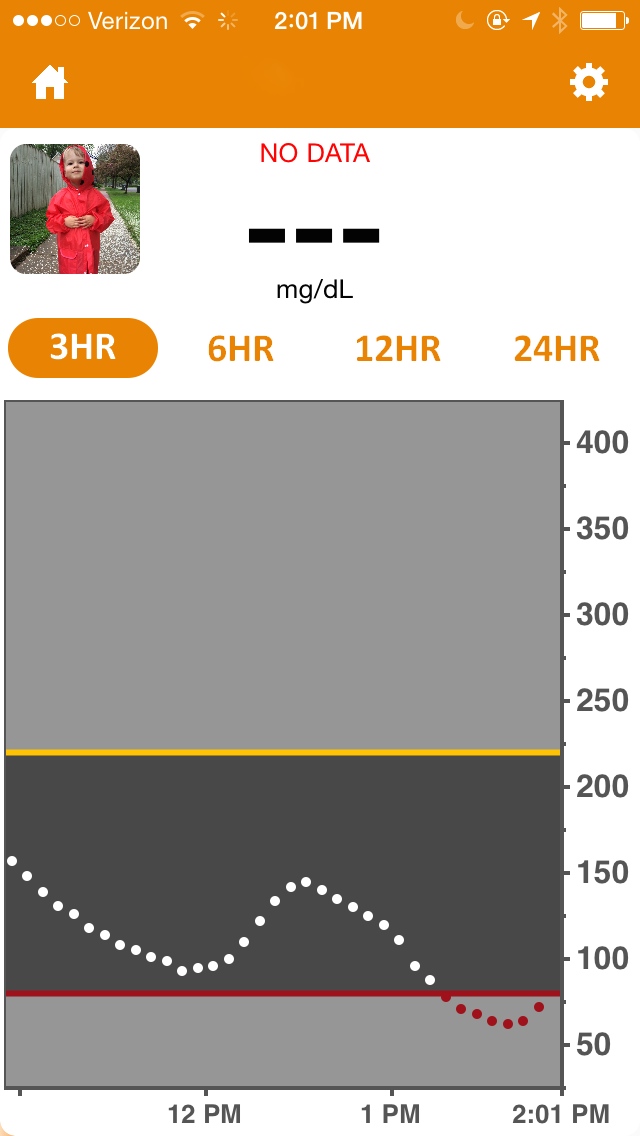
IMG_6652

7. What do you imagine?

8. Lucid, inescapable numbers?

9. Illusion of perspective—

flown, offline, out of sight?
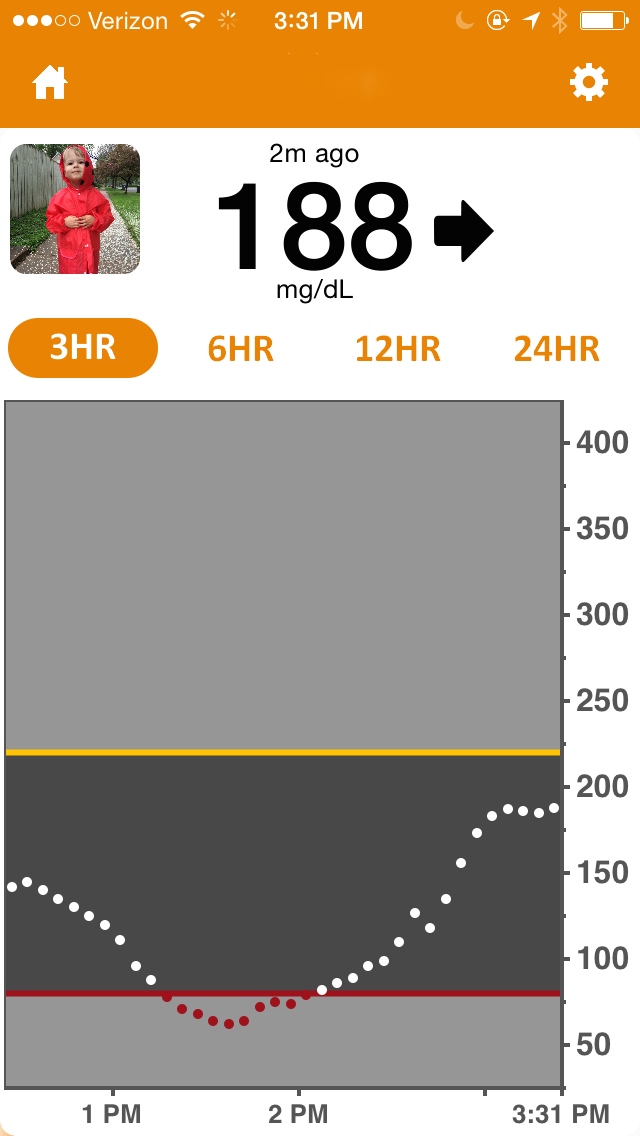
IMG_6654

10. Euphony, at a line,

a bird to horizon.

11. Not mostly, but once,

a fear usually pierces.

Even when it’s mistook.

12. The insulin or sugar is moving.

IMG_6664

13. It was all night into morning.

It was no sleep into half-sleep.

T1D Helicopter Parents Unite!

I used to teach English at a distinguished college preparatory high school in Los Angeles. Occasionally, the faculty would bemoan the “helicopter parent” after an exhausting and ghastly encounter. For example, a father told me his son, a sophomore in my composition class, could not complete the homework because the son was sad his pet goldfish died. Another mother drove her son’s homework to school after she completed it for him. At my classroom door, in front of his class, she explained he was too excited to do his homework last night after he found out he made the freshman football team.

Even helicopter parents understand that if they always tie their child’s shoe, the child will never learn to tie a shoe. But parenting is a complicated paradox: as a parent, my job is to make myself obsolete. The whole business of parenting is weaning. The process of weaning and independence is  easy to see with young children, when desire precedes ability, and they want to pour the milk or pick out their own clothes. After many days and years of scaffolding independence the hope is my children will get an education and job, be able manage money, make decisions to safeguard their health, find people that make them happy, and join communities.

That’s how the whole plan is supposed to proceed, but the plan requires revision when a chronic disease enters the scenario. Our four year old has type 1 diabetes. Now our job is to aim for all the aforementioned things, but also to daily administer a drug, insulin, which preserves his life, but could take it. In a few years, we’ll have to teach him how to deliver this same drug. We have to teach him how to wear medical equipment (Animas pump and Dexcom) on his body 24 hours a day and how to take care of this equipment. We’ll have to teach him how to heal and advocate for himself when he encounters unkind or ignorant people.

School is starting, so a parade of parents are meeting with educators and administrators about 504 plans, and educating staff on caring for a student with T1D. In her article, “What It’s Really Like To Raise A Child With Diabetes” on The Huffington Post, Lisa Gastaldo explains some of the fears and realities of diabetes care from a parent’s perspective, as well as her history of working well with schools and doctors. I think it’s a great read to pass along to teachers and family members who may not recognize the trials of living with diabetes.

Even people who are in the diabetes community debate when and what a parent’s role in T1D care should be. As CGM in the Cloud and Nightscout emerged and engaged in important debate with Dexcom over moving to an FDA approved platform that enabled sharing of CGM data, people in the diabetes care industry predicted that the helicopter parents of T1D children would be distracted and consumed by the data. We’ve had Dexcom share since June, and have found the opposite to be true. Rather than wondering what our son’s blood glucose is, and texting or calling to find out, we look at the number and move on. We’ve been able to leave our son with family members for the first time since diagnosis. Just this week, both of Henry’s preschool teachers downloaded the app on their phones and marveled at how this continuos stream of information would make monitoring and care easier in the classroom.

Dexcom Share data on follower phone

Dexcom Share data on follower phone

My job is primarily to be a parent, but as I watch my four year old son struggle to put on a pair of pants while holding an insulin pump, I realize my other more arduous job is to be a parent to a person with type 1 diabetes. How long do I watch him try to untangle the tubing from his pants before I step in? To stall, I play a trick on myself and say this is like any other challenge every other kid faces, right? I tell myself only the scenario is different, but then Henry looks at me in frustration. He asks for help, and I can see on his face that he knows this struggle is different, more intricate and undue. There’s no need to say anything in this moment that requires action. Instead, we sit down on the floor, where he can place his pump, and find a new way to put on pants.

Caregiver Cheat Sheet

Last summer I sat on the floor outside the room while Henry was in art camp. He’d been diagnosed with T1D five months prior, and he’d been on the pump for the last two months. The camp was only one week long, so surly I could just sit on the floor and meet him for snack time and watch the Dexcom (this was pre Share), right? I sat on the floor and Henry loved art camp. However, I had ample time to contemplate the fact that until Henry is old enough for self-management, we can no longer drop Henry off at school, camp, a friend’s house, a birthday party, or even leave him with a family member, without talking about diabetes care.

When you tell someone about diabetes care, I’ve noticed three general reactions.

  1. A glazed over look appears in the eyes, then mouth, and invades the general posture of the listener. Do not leave your child with this person.
  2. The listener sort of gets it, and starts asking questions like, “You have to do that every two hours?” “You mean he can have sugar?” “So the pump doesn’t automatically know how much insulin to give him?” Leave your child with this person only after feedback loop systems are the standard of care or after you’ve had several more conversations about diabetes.
  3. Shaky hands accept the medical devices and instructions. Usually this person says something like, “I will call and text you.” Two minutes after you’re in the car, there’s a call, but you know this person can handle it.

Obviously it’s never a good idea to leave a child with diabetes with a caregiver who does not understand the basics of diabetes or is unwilling or too nervous to administer care. However, it is possible to train willing family and friends. To help our willing family members, babysitters, and preschool staff, we created a caregiver cheat sheet. The sheet covers: blood glucose range, hypo & hyper treatments, carbs for meals, Animas pump information, and Dexcom CGM information.

caregiver cheat sheet

Here’s the link to the document you can download and edit to specific person with diabetes and product information.

Link to Caregiver Cheat Sheet

Taking a Pancreas in Your Pocket to the Beach

In everyday normal life with diabetes we search for the meter-remote, a vial of test strips, new lancets, batteries, the Dexcom receiver, glucose tabs, juice, the Dexcom receiver, the phone/s to which the Dexcom Share data is downloaded. Repeat. Repeat. Repeat.

Despite being organized (the up-cycled D-Bag aside), I’ve managed to run over a Dexcom receiver in the preschool parking lot (the up-cycled D-Bag’s fault). In the frantic moments when I’m searching for a needed medical device while fixing lunch or getting ready to run an errand, I’m overwhelmed with the impossibility of replicating a human organ, which is, of course, impossible. However, thanks to technology, T1D is getting easier to manage. Pumps, continuous glucose monitors (CGMs), and hopefully closed loops systems will make management of T1D easier. We’ve certainly seen innovation since the first insulin pump in early 1970s.

model of first portable insulin pump, early 1970s

Our son is 4, so finding creative ways to carry his Animas pump, CGM receiver, and the iPod to which the data is downloaded is challenging. The challenge triples at the beach. Yesterday, the new Dexcom receiver took a *quick* dip in the kiddie pool. Now it’s spending some time in a bag of rice with an ocean view. If you’re not a member of the FB group Dexcom, consider joining this group as it offers great suggestions for using Dexcom, especially when it’s been swimming.

People with diabetes can do everything anyone else can; however, there’s more planning and worry involved. This is our first summer at the beach since diagnosis. We’re learning a lot about pumping in hot weather and conducing some experiments in regards to “waterproof” versus “water resistant.”

Our son has diabetes, but we’re lucky enough to be at the beach. We are at the beach. We are at the beach, but so is diabetes. We are at the beach.

diabetes at the beach in the foreground

diabetes at the beach in the foreground

diabetes at the beach with beach in background

diabetes at the beach with beach in background

Both are simultaneously true.